
AI needs real data to create real value
 Graham WattsPublished 2026-04-23
Summary: Generative AI excels at imitation but lacks reasoning and understanding of reality. Without access to trusted, real-time data pipelines, AI analyses produce plausible-sounding but unreliable results. Learn how Model Context Protocol servers and semantic layers enable AI to access curated, trustworthy data—transforming AI from a hallucination risk into a reliable decision-making tool.
AI, the new way to interact with technology
AI systems are engaging to work with. They mimic natural conversation, generate thoughtful answers, and communicate in ways that feel validating and easy to understand. They excel at predictable, repetitive tasks that consume hours of human time. Working with AI feels like having a tireless, always-available assistant—one that never tires, complains, or refuses a request.
It's no wonder businesses are rushing to integrate AI into their operations, hoping to boost productivity and cut costs. Because AI is so easy to use, it's tempting to overestimate what it can do and overlook the risks of relying too heavily on its output.
What AI actually does
Large language models (LLMs) and other AI systems are trained on real-world examples. During training, they learn patterns from that data so they can match new prompts to similar cases and generate comparable outputs. AI models are exceptionally good at imitation, but they have no genuine understanding of what they learned or whether their results are accurate.
When AI produces something that doesn't make sense, we call it a "hallucination." But the term is misleading. When people hallucinate, they perceive something that contradicts their understanding of reality. AI systems have no concept of reality—no way to know whether an output is true or false. They only reproduce what they've learned. To an AI, a false answer is as real as a correct one.
Better training data does improve AI results, because the system imitates higher-quality examples. But the results are still generated—invented by the model. Training can only take you so far. When the AI encounters a situation with no close parallel in its training data, it still generates an answer, even if that answer is unreliable. You wouldn't run your business on invented data, so why trust AI results that are essentially the same?
You wouldn't run your business on made-up data
Picture a strategy meeting where the team examines current KPIs and discovers everyone has slightly different values. Even if the numbers are close, you can't trust any of them—they can't all be right. How do you know which ones are accurate?
Often, those numbers aren't fabricated; they differ because they're from different time periods, use different calculations, or apply different techniques. Yet the meeting stalls because no one can trust the fundamental data their decisions depend on. Real business decisions require real numbers everyone can depend on and trust.
So why do we trust what AI generates? AI excels at producing results that feel real because they're close to its training examples—but they aren't real. Business data that feels correct may be entirely wrong for your specific situation. The numbers have to be right, every single time.
What AI is missing to earn your trust
A trusted data expert doesn't just learn from past cases; they apply reasoning to validate data. They examine the data source, understand the calculation logic, and assess whether the numbers make sense. They draw on general knowledge and experience to sense when something is off and investigate further. This kind of reasoning is abstract and beyond current AI capabilities.
Reasoning in AI is an active research area and part of the larger quest for artificial general intelligence (AGI)—a future where AI handles most aspects of human intelligence. When you ask AI researchers what AGI looks like or when it will arrive, you get vastly different answers because no one fully understands how human reasoning works. It's reasonable to assume AI will develop some form of reasoning eventually, but it's clear the technology lacks that capability today.
Adding trust to generative AI
We can't expect AI to guarantee correct answers to data-based business problems on its own. But we can give AI the tools to reach the right results without generating them. This approach lets AI access proper data pipelines with curated, reliable business data and incorporate that data into its responses. The AI handles the interaction with the decision maker, determines which analyses to run based on learned patterns, and generates the response—but it uses APIs to fetch the right data from the right sources to fill in the actual numbers.
One emerging technology for this is the Model Context Protocol (MCP) server. An MCP server is an API made available to AI, complete with built-in instructions that tell the AI what it does, how to use it, and how to interpret the results. Using an MCP server removes the generative guesswork from the data part of AI responses.
Building an ideal data pipeline
Before you set up an MCP server to feed AI the right data at the right time, you need a modern data stack with enough clarity and context around your data for proper interpretation. Data clarity matters for people, but it's even more critical for AI systems that can't reason through missing context. When context is absent, generative AI systems guess—and guessing leads to hallucinations.
Semantic and metric layers are emerging technologies designed to expose transformed data with added context so it can be interpreted easily and unambiguously by anyone who consumes it. They're ideal for AI systems that access data through MCP servers and need to retrieve the right information and interpret it correctly to generate reliable business analyses.


Introducing the PowerMetrics MCP server
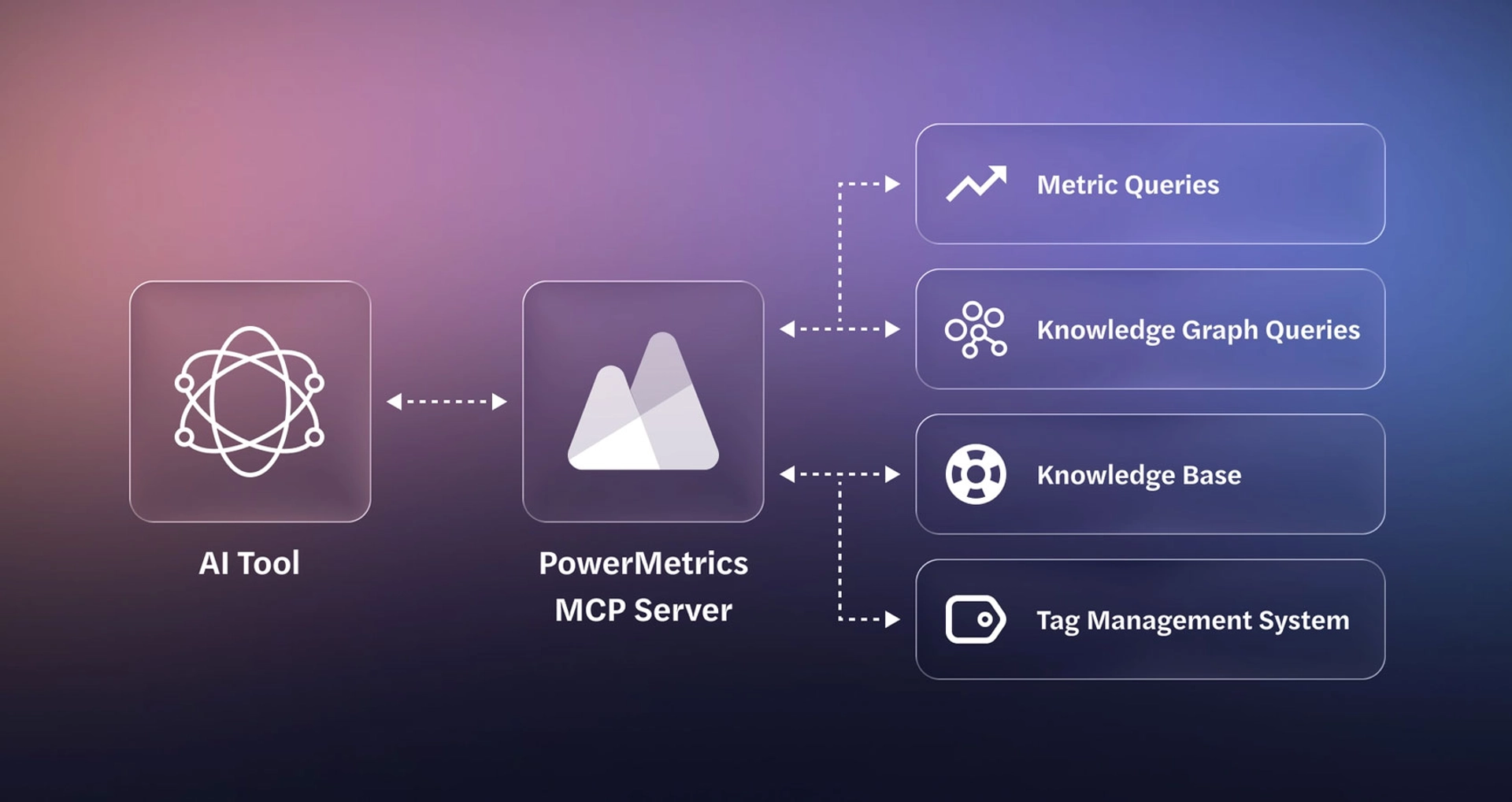
PowerMetrics now offers an MCP server that allows AI systems to access metrics curated by your organization's data team. PowerMetrics also generates a knowledge graph showing how metrics and other artifacts in your data stack relate to each other, giving AI better context to reason about available metrics and suitable analyses.
The PowerMetrics MCP server exposes a set of tools for AI to query the knowledge graph and retrieve data from metrics directly. Together, these tools give AI an up-to-date view of your current data and direct access to it—so it won't have to generate plausible-sounding but ultimately false results. Real data, real insights, real value.