
The Secret Weapon: Semantic Clarity

 Allan WillePublished 2025-12-10
Summary: This is the second article in a three-part series on adopting the CDAIO Mindset. The first article argued that growth-stage and mid-market companies need to appoint a 'Data Champion'—a fractional data leader—to own the data strategy and drive business value, rather than hiring a costly Chief Data, Analytics, and AI Officer (CDAIO).
In the world of enterprise data leadership, the single most expensive and time-consuming challenge is data governance. This is the framework of rules, policies, and processes designed to ensure data is trustworthy, compliant, and useful. For large corporations, this means wrestling with decades of legacy systems and mountains of chaotic data. The cost and complexity are prohibitive, often slowing both analytics and AI adoption to a crawl.
For a growing company, this challenge can be simplified and transformed into a powerful competitive advantage. You don't need a massive governance committee; you need semantic clarity. This is the secret weapon that allows your lean team to build data trust faster than your larger competitors, laying the essential groundwork for high-impact analytics and AI value.
The subtle tyranny of semantic confusion
Semantic confusion occurs when the fundamental business vocabulary—your core metrics—are defined differently across your organization. This is often an insidious problem, invisible until a crucial moment of decision-making.
Consider the simple metric of New Customer Count. The Sales Director may define it as anyone who signed a contract this month. The Finance Director may define it as only those customers who have fully paid their first invoice. The Marketing Manager may define it as anyone who converted from a lead source. Each department, working from its own spreadsheet or reporting tool, is technically "correct" according to its own isolated logic.
The result, however, is disastrous:
Lost trust: When the CEO receives three different reports on a key metric, confidence in the entire data ecosystem evaporates. The team reverts to intuition or the loudest voice, rendering all analytics moot.
Flawed decisions: You cannot accurately calculate the true Customer Acquisition Cost (CAC) if you don't have a single, unified definition of what constitutes an acquired customer. This leads to poor investment decisions, wasted advertising spend, and inaccurate forecasting.
AI paralysis: AI and advanced analytics are only as intelligent as the data they are fed. If you feed an AI model three different definitions of "revenue," its predictions will be useless, immediately compromising the ROI of your investment.
Semantic clarity is the answer. It is the mandate of the Data Champion to stop asking "Is the data clean?" and start asking "Do we all agree on what this metric means?"
The Data Champion's governance, simplified
The enterprise CDAIO ensures governance through bureaucracy and compliance. The Data Champion achieves it through enforcement and standardization. Your goal is to move from a chaotic system where metrics are calculated individually by every analyst to a streamlined system where metrics are defined once and used everywhere.
This process is built on what we call the metric layer—a foundational, authoritative dictionary for your entire business.
Define the metrics: This starts with the Data Champion selecting the 3–5 metrics that dictate success (as argued in the first article).
Formalize the definition: For each metric, the Data Champion must convene the relevant stakeholders (Sales, Finance, Ops) and collaboratively formalize the exact calculation, time window, and data sources. Example: CAC is defined as (Total Marketing + Total Sales Salaries) / (Total new, paying customers in the same period).
Establish a single source of truth: This is where the right technology is essential. A fast-growing company cannot manually police every spreadsheet. A dedicated data analytics platform like PowerMetrics becomes the metric layer—the sole tool where these definitions are housed, maintained, and certified. It connects to all your data sources (CRM, accounting, inventory) and ensures that when any user pulls the "CAC" metric, they are pulling the official, governed calculation.
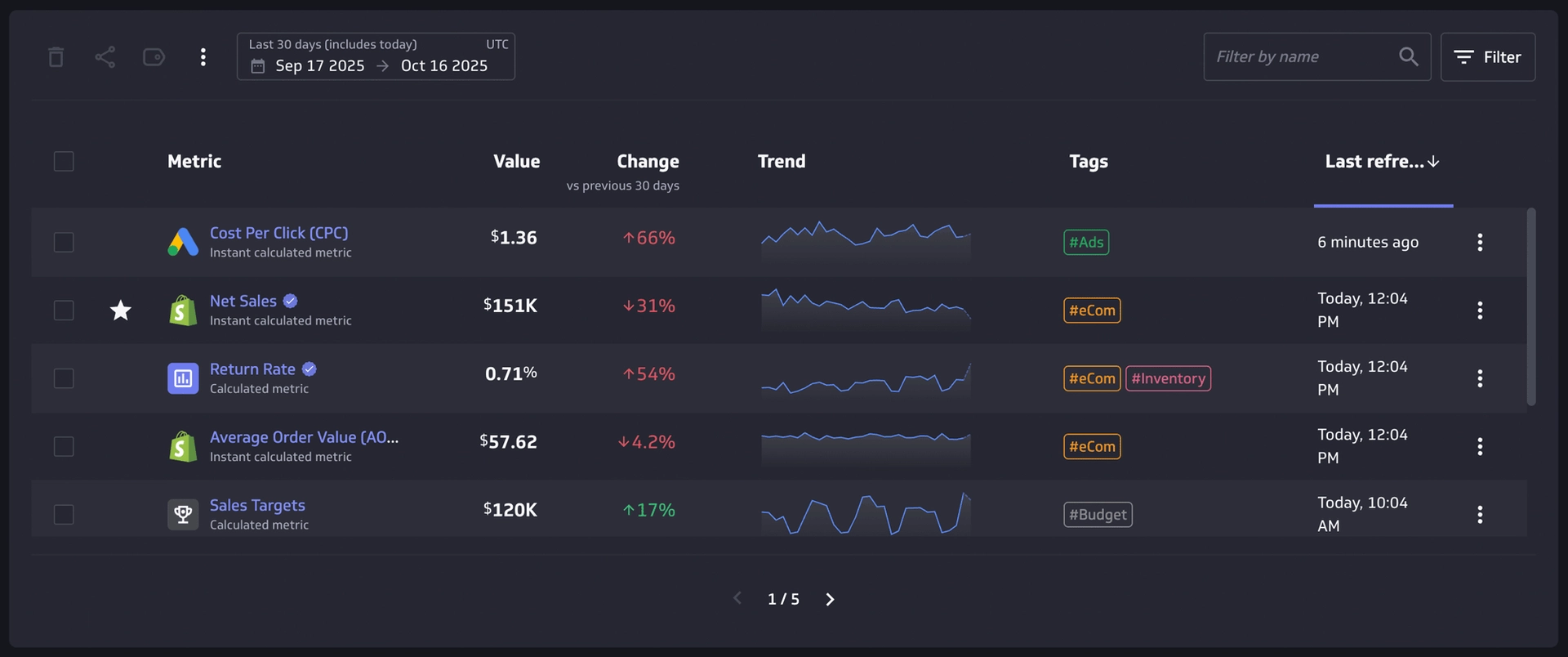


The trust pillar: foundation for an AI future
The power of semantics—and an ontology that your company agrees upon—is that it creates trust instantly and economically. When the data is organized and presented as a catalog of metrics, your business gains four immediate, high-impact benefits:
Accelerated decision-making: No more wasted time arguing over numbers. The focus shifts entirely from reporting the past to deciding the future.
Reduced risk: Compliance and financial auditing become simpler because the core financial metrics are standardized and auditable.
True collaboration: Teams stop hoarding data and start collaborating around a shared, agreed-upon reality. When everyone is looking at the same trusted numbers, departmental goals align naturally.
AI readiness: By cleaning and unifying the definitions of your output metrics (like revenue and LTV), you create the perfect, high-quality training data for AI models. You've defined the target; now the AI can learn how to hit it.
A growth-stage company's limited data team (or lack thereof) is often cited as a weakness. By leveraging semantic clarity and a unified metric layer or catalog such as PowerMetrics, this perceived weakness becomes a strength. You bypass the bureaucratic nightmare of enterprise governance and jump straight to the efficient, agile system that drives competitive advantage. The ability to trust your metrics is the cornerstone of the CDAIO mindset, and it's the single most important action your team can take today to prepare for the age of AI.