
In an Instrumented Age, One Conversation Still Matters Most
 Allan WillePublished 2026-01-14
Summary: In a time when dashboards, transcripts, and AI summaries are everywhere, the fastest path to clarity still looks old fashioned: talk to a user, listen carefully, and watch them work. One candid conversation cuts through noise, surfaces nuance, and strengthens the relationship that makes products better.
The most underrated advantage in product companies
Teams spend on tools, instrumentation, and reports, then skip the part that changes everything: a direct conversation. Data shows what happened. A user tells you why it happened, in their words, in their context. That mix brings better judgment and fewer detours.
This holds for any product team, early stage or mature. Startups need fast truth. Established teams need to avoid calcifying around assumptions. Either way, the edge is simple. Keep talking to customers.
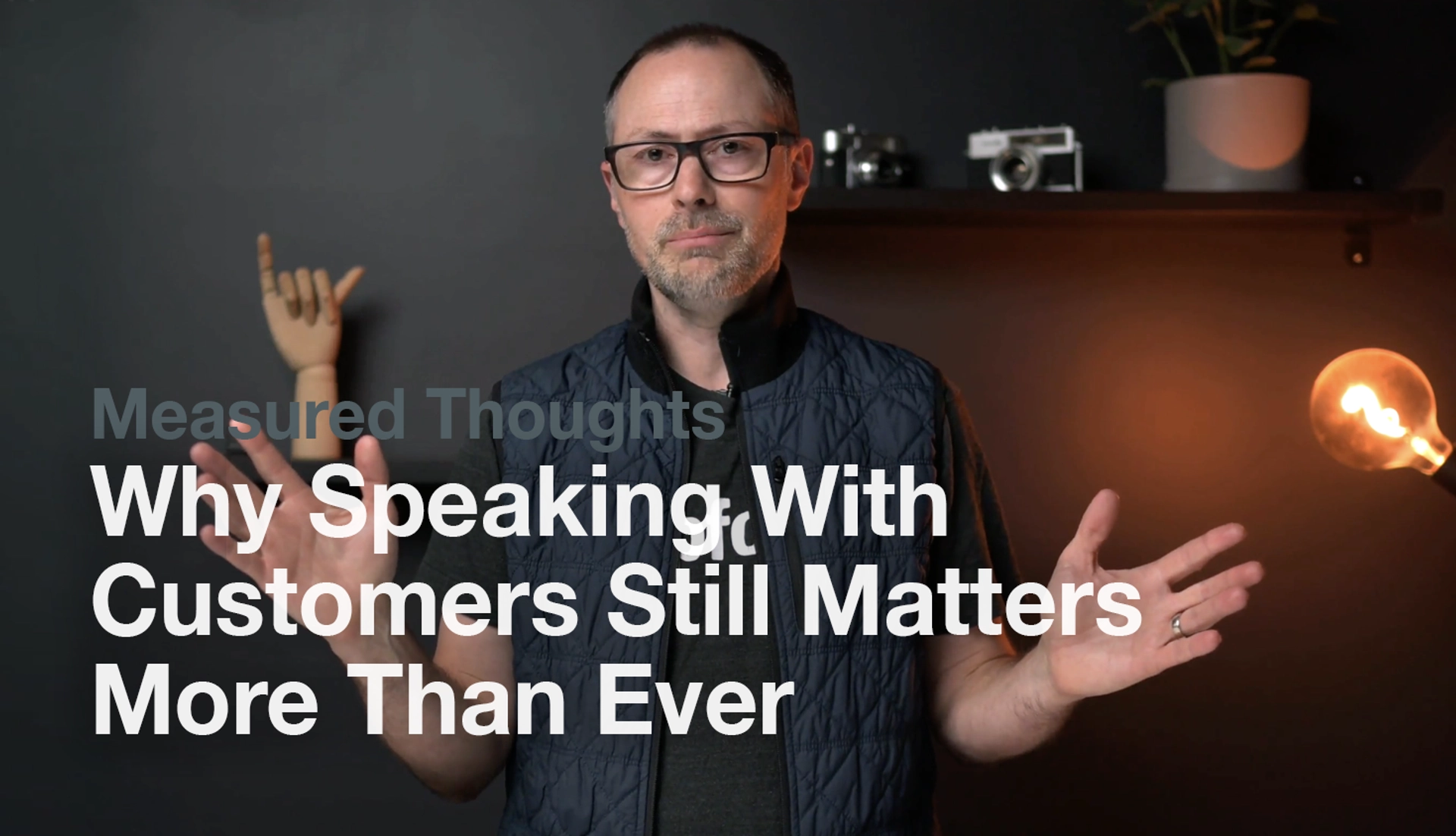
Watch this quick video to see what I mean:
Face time matters more than ever
Surveys, tickets, and analytics are useful. Live conversations go further. When you sit with a customer, you see the tab they keep open, the workaround they hide in a spreadsheet, the moment their cursor pauses before a choice. Those small cues rarely show up in a chart, yet they explain behaviour.
Customer Success and Support capture a lot. Product leaders, designers, and engineers still need firsthand exposure. We've found that a single session can reframe a roadmap item, break a tie in prioritization, or reveal a simpler path that would never appear in a backlog groom.
What you actually learn when you listen
Break the learning into four buckets so the team can act on it.
Usage
- Reality versus intent: How people actually navigate, which paths they favour, which features sit ignored.
- Sequence: The order tasks happen in, and where the flow collapses.
- Workarounds: Hidden spreadsheets (yes, users love spreadsheets!), copy-paste rituals, private scripts.
Outcomes
- In their words: What a successful task looks like, using their language, not yours.
- Time horizons: Daily tasks versus quarterly shifts.
- Signals of value: The moment they share the dashboard, the report they forward, the alert they trust.
Expectations
- Assumptions at purchase: What they thought the product would do on day one.
- Mental model: How they believe the system should behave.
- Surprises: Pleasant and painful, both matter.
Gaps and friction
- Missing pieces: The feature they expected to find.
- Mismatched defaults: Sensible for you, confusing for them.
- Paper cuts: Small, frequent annoyances that compound into churn risk.
Useful prompts to help users feel safe and express themselves:
- Which features feel missing right now?
- If you had a magic wand, what would you change first?
- What surprised you, good or bad?
- What were you trying to solve when you chose this product?
- If this product disappeared tomorrow, how disappointed would you be? (The Sean Ellis test.)
Asking better questions
Listening is a skill. The goal is to learn, not to confirm.
- Stay open-ended: Ask questions that invite stories, not yes or no.
- Avoid leading phrasing: Swap “Do you like the new layout?” for “Walk me through how you’d complete this task.”
- Go a layer deeper: After each answer, ask “What makes that important?” or “Can you show me?”
- Sit with silence: Let people think. The next sentence is often the insight.
Prompts that are simple and can work in almost any situation:
- What would you do differently if you were building this?
- Where did you hesitate?
- What did you expect to happen at this step?
- What would you teach a new teammate about using this tool?
From conversations to patterns
A single story helps, patterns decide. Treat each interview like a data point, not a directive.
- Cluster themes: Group similar quotes, screenshots, and moments. Name the theme in the customer’s words.
- Separate edge cases: Note them, do not let them steer the ship.
- Form hypotheses: Turn themes into clear bets the team can test.
- Test in the market: Put scrappy prototypes in front of users, not just internal demos.
- Close the loop: Share what changed with the customers who helped.
Listening does not mean building every request. It means using judgment that is grounded in reality, then validating choices quickly.
Why direct conversations beat systems alone
Tools collect the signals. Conversations add the story.
- Tone and emotion: Enthusiasm, hesitation, frustration, relief. These shape priorities.
- Context: Which browser, which integration, which goal. The setting explains the behaviour.
- Sequence and pace: Where time gets lost, where flow stops, where success feels smooth.
Support tickets, NPS, and feedback forms are essential inputs. They work best when paired with regular, direct conversations that bring nuance to the numbers.
The two-way street
When leaders and builders make time for users, trust rises. People feel heard. They start sharing ideas earlier, not just when something breaks. That creates shared ownership in the product’s evolution and turns customers into advocates.
The relationship gains strength in both directions. You learn. They influence the future. Everyone moves faster because the conversation never stopped.
A simple practice kit
Make it easy for teams to keep talking to customers.
- Set a monthly cadence: Two to four sessions per product area, recurring invites on the calendar.
- Recruit in context: Invite users from varied segments, roles, and tenures. Rotate to avoid tunnel vision.
- Share a short brief: One page with goal, prompts, and success criteria. Keep it light.
- Record with consent: Store highlights, not just full videos. Tag by theme for easy retrieval.
- Debrief immediately: Ten minutes to capture quotes, surprises, and potential bets.
- Turn takeaways into actions: Add one change to the backlog, one follow-up test, one note back to participants.


An open invitation
Many companies rarely speak with users. The cost is real: slower learning, confident but wrong bets, and a weaker relationship with the people who matter most. Keep the dialogue going. Schedule time, ask better questions, and share back what changed.
Got an idea, an aspiration, or a frustration worth airing? Share it. Contact me directly. Book fifteen minutes. Reach out!