Top Metrics For Successful Leaders: The Modern Playbook

 Allan WillePublished 2026-04-02
Summary: You can run your business on fewer, clearer metrics. This guide gives a role-by-role set for leaders at fast-moving, growing small and mid-sized companies, then maps targets for two stages: 1) growth and 2) profitability. Use it to build a shared metric catalog in PowerMetrics and make faster, better calls with trusted data.
I know you're battling data fragmentation and misalignment. Finance reports one number, sales another, and product uses separate event data. When every team defines key performance indicators (KPIs) differently, the result is conflicting priorities, delayed decisions, and eroded trust across the executive team.
Here's the thing: to make faster, smarter decisions, leaders must unify their data into a single source of truth. This system provides the essential context to help prioritize the correct metrics—those that directly drive meaningful growth, operational efficiency, and cash flow—and ultimately, help everyone make better decisions.
A shared metric catalog resolves misalignment by ensuring every critical measure is defined identically across the organization. Each KPI must have a clear owner, an exact formula, and a consistent refresh cadence. Tools like PowerMetrics transform this catalog into a live, governing system with goals, alerts, and shared views, ensuring every team speaks the same numerical language.
Your leadership metric system: A 7-step playbook
Building an effective metric system requires rigour and discipline. Follow these steps to establish immediate clarity and long-term governance:
- Define the core: Start with 3–5 company-level metrics that the entire executive team reviews weekly. This narrow focus sets the strategic tone for the organization.
- Make definitions unambiguous: Write the exact formula, time window, and specific inclusions or exclusions. Example: Is "Customer" an account or a user? Define it once.
- Assign ownership: One person must be accountable for maintaining each metric, its definition, and its context.
- Connect sources: Point metrics directly at the system of record (e.g., CRM, Billing System) and set an automated refresh cadence (e.g., 15 mins, 4 hrs, 12 hrs), or build a centralized data warehouse that feeds the metric system.
- Set targets: Create clear growth and profitability targets. Explicit targets make trade-offs transparent and motivate action.
- Publish and share: Deploy metrics and dashboards tailored by role, plus a single, unified leadership view for the executive team.
- Establish a review cadence: Implement a rigorous cycle—weekly leadership review, monthly deep-dive analysis, and quarterly target reset.
Executive metric playbook: By role
The following is a curated set of high-leverage metrics that work across most small to mid-sized businesses (SMBs). Choose the few that matter most, then add your company-specific measures.
CEO: Focus on durable growth and quality of revenue
Primary Goal: Compound long-term value while protecting cash runway.
| Metric | Definition & Formula | Why It Matters | Cadence |
|---|---|---|---|
| Net Revenue Retention (NRR) | Expansion + Renewals − Contraction − Churn, as % of starting revenue. Formula: (MRR Starting + Exp − Cont − Churn) / MRR Starting | Judge of product-market fit depth and expansion health. High NRR fuels durable growth. | Monthly & Quarterly |
| Revenue Growth Rate | Period-over-period revenue change. Formula: (Rev This − Rev Last) / Rev Last | Core pace-setter for company value creation. | Weekly & Monthly |
| Burn Multiple | Net burn divided by net new Annual Recurring Revenue (ARR). Formula: Net Burn / Net New ARR | Efficiency lens. Measures how much capital is burned to generate each dollar of new ARR. | Monthly |
| Rule of 40 (Recurring Rev Models) | Revenue Growth Rate + Operating Margin | Blends growth and profitability into a single health measure. | Quarterly |
| Employee Engagement (eNPS) | Share of promoters minus detractors from an employee survey. | Indicator of organizational health, talent retention, and future productivity. | Quarterly |
COO: Build repeatable, efficient execution
Primary Goal: Ship on time, improve quality, and reduce unit cost.
| Metric | Definition | Why It Matters | Cadence |
|---|---|---|---|
| On-time Delivery Rate | Share of orders, projects, or releases delivered on or before the due date. | Reliability builds customer trust and predictable cash flow. | Daily & Weekly |
| Cycle Time | Average time from start to completion for a process (e.g., production, project). | Faster loops, lower Work-in-Progress (WIP), higher throughput. | Weekly |
| Gross Margin | (Revenue − Cost of goods sold) / Revenue | Foundation for pricing and operating flexibility. Must beat unit economics target. | Monthly |
| First-Contact Resolution Rate | Share of support issues resolved in the first interaction. | Lower cost-to-serve and better customer experience. | Daily & Weekly |
| Operating Expense Ratio (OpEx/Revenue) | Operating expenses divided by revenue. | Measure of spending discipline relative to growth. | Monthly |
CFO: Protect runway and improve unit economics
Primary Goal: Balance aggressive growth with essential cash discipline.
| Metric | Definition & Formula | Why It Matters | Cadence |
|---|---|---|---|
| Cash Runway (months) | Months until cash hits zero at current net burn. Formula: Current Cash / Monthly Net Burn | Survival and optionality. The ultimate health measure for growing businesses. | Monthly |
| Operating Margin | Operating income / Revenue | Cost discipline and overall operational profitability. | Monthly & Quarterly |
| Free Cash Flow (FCF) | Cash from operations minus capital expenditures. | True health after all growth spending. | Monthly & Quarterly |
| Days Sales Outstanding (DSO) | Average days to collect receivables. | Working capital efficiency and collection speed. | Monthly |
| Net Dollar Retention (NDR) | Recurring revenue kept and expanded from existing customers (similar to NRR). | Resilience of the existing customer base. | Monthly |
CMO: Create efficient, compounding demand
Primary Goal: Produce qualified pipeline and rapidly improve payback periods.
| Metric | Definition & Formula | Why It Matters | Cadence |
|---|---|---|---|
| Pipeline Generated (Marketing-sourced) | Qualified pipeline value directly sourced by marketing efforts. | Fuels sales bookings predictability and justifies spend. | Weekly |
| Customer Acquisition Cost (CAC) | Sales and marketing cost to acquire one new customer. Formula: Sales & Marketing Spend / New Customers | Affordability of growth. Must decline as the business scales. | Monthly |
| CAC Payback Period | Months to recover CAC from gross margin. | Speed to recover marketing spend. Lower is always better. | Monthly |
| Cost per Lead (CPL) | Spend divided by qualified leads. | Channel efficiency and cost control. | Weekly |
| Marketing Qualified Leads (MQLs) | Leads that meet an agreed behavioural and fit threshold. | Volume and quality of top-of-funnel output. | Daily & Weekly |
CRO (Chief Revenue Officer): Grow predictable, high-quality revenue
Primary Goal: Hit bookings targets with a healthy mix and efficient cycle times.
| Metric | Definition | Why It Matters | Cadence |
|---|---|---|---|
| New ARR / Bookings | Contracted new annual recurring revenue or total booked contract value. | The primary new revenue engine. Must beat plan. | Weekly & Monthly |
| Pipeline Coverage | Pipeline value for next period / Quota for that period. | Confidence and safety margin for the sales forecast. | Weekly |
| Win Rate | Closed-won deals / all closed deals. | Selling quality, accurate forecasting, and product-market fit. | Weekly |
| Sales Cycle Length | Average days from qualified opportunity to close. | Velocity of the sales motion. Shorter is more efficient. | Weekly |
| Expansion ARR | Added recurring revenue from existing customers. | Resilience and future proofing of recurring revenue. | Monthly |


CPO (Chief Product Officer): Drive adoption and value
Primary Goal: Improve product-led growth, retention, and customer satisfaction.
| Metric | Definition | Why It Matters | Cadence |
|---|---|---|---|
| Weekly Active Users (WAU) | Unique users who complete a meaningful action in the last 7 days. | Core measure of adoption and habit. | Weekly |
| DAU/WAU Stickiness | Daily active users / weekly active users. | Habit strength. High stickiness correlates with higher retention. | Weekly |
| Time to Value (TTV) | Median time from sign-up to first key activation event. | Measures onboarding friction. Low TTV drives early retention. | Weekly |
| Churn Rate | Lost customers / starting customers for the period. | The clearest signal of lost value and poor product fit. | Monthly |
| Product Net Promoter Score (NPS) | Promoters minus detractors from in-product survey. | Satisfaction, advocacy, and referral potential. | Monthly |
CTO: Ship reliably and drive innovation
Primary Goal: Raise delivery throughput without sacrificing stability.
| Metric | Definition | Why It Matters | Cadence |
|---|---|---|---|
| Deployment Frequency | Average number of production deployments per day or week. | Throughput and speed of value delivery. | Weekly |
| Lead Time for Changes | Average time from code commit to production. | Flow efficiency and time to market. | Weekly |
| Change Failure Rate | Share of deployments that cause a service incident or rollback. | Release quality. High failure rate destroys trust and velocity. | Weekly |
| Mean Time to Recovery (MTTR) | Average time to restore service after an incident. | System resilience and speed of response. | Weekly |
| Uptime (SLA) | Percentage of time services are available. | The core reliability promise to customers. | Weekly & Monthly |
| Cloud Cost per Active User | Total cloud spend / active users for the period. | Cost-to-serve control as scale increases. | Monthly |
Summary matrix: Metrics and priorities by stage
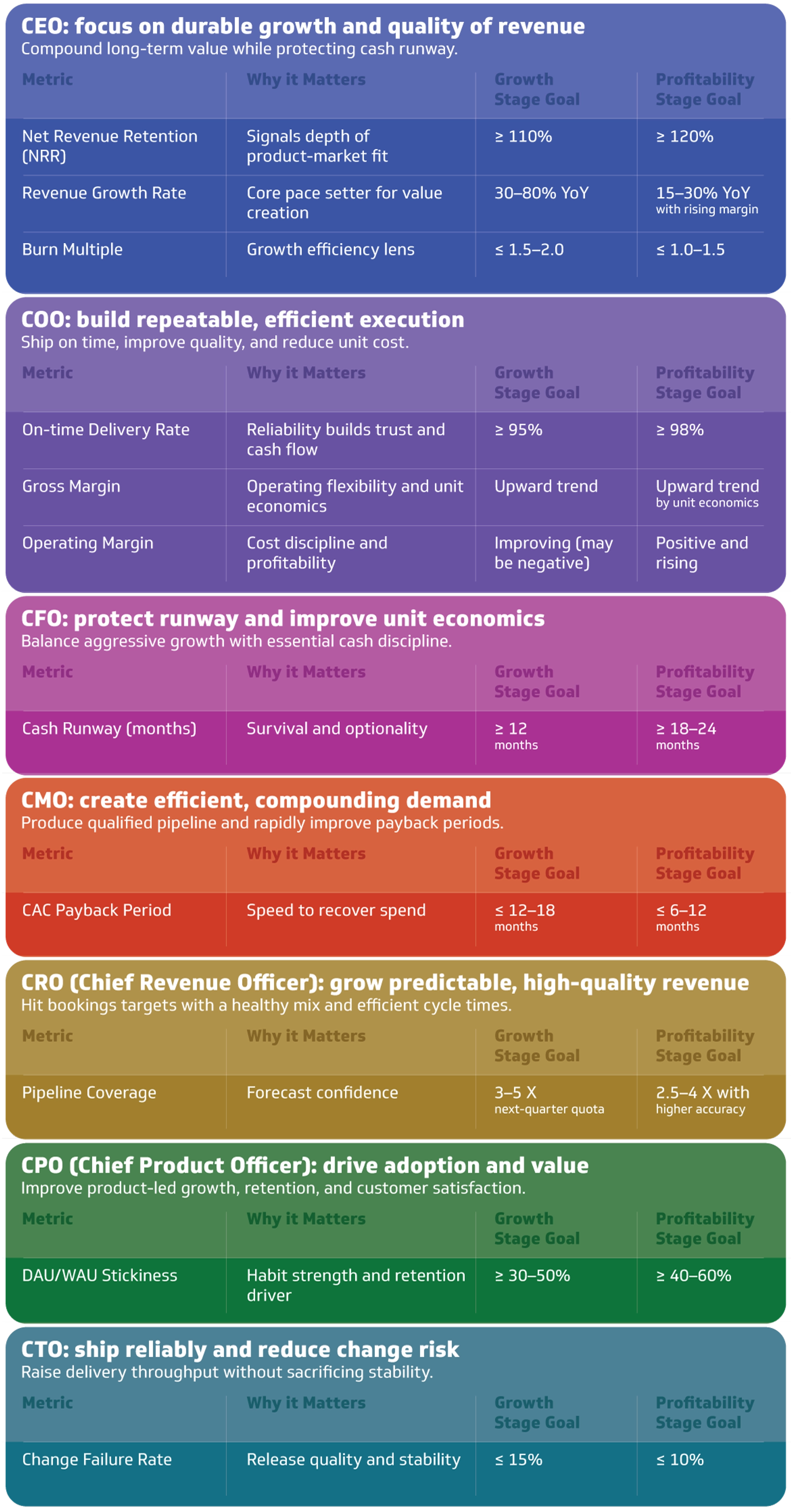
The goals for a high-growth company prioritizing market share are fundamentally different from one focused on maximizing profit. The matrix below summarizes the most important metrics and how success shifts from the Growth stage to the Profitability stage.
| Role | Metric | Why it matters | Growth stage goal | Profitability stage goal |
|---|---|---|---|---|
| CEO | Net Revenue Retention (NRR) | Signals depth of product-market fit | ≥ 110% | ≥ 120% |
| CEO | Revenue Growth Rate | Core pace setter for value creation | 30–80% YoY | 15–30% YoY with rising margin |
| CEO | Burn Multiple | Growth efficiency lens | ≤ 1.5–2.0 | ≤ 1.0–1.5 |
| COO | On-time Delivery Rate | Reliability builds trust and cash flow | ≥ 95% | ≥ 98% |
| COO | Gross Margin | Operating flexibility and unit economics | Upward trend | Upward trend by unit economics |
| COO | Operating Margin | Cost discipline and profitability | Improving (may be negative) | Positive and rising |
| CFO | Cash Runway (months) | Survival and optionality | ≥ 12 months | ≥ 18–24 months |
| CMO | CAC Payback Period | Speed to recover spend | ≤ 12–18 months | ≤ 6–12 months |
| CRO | Pipeline Coverage | Forecast confidence | 3–5 X next-quarter quota | 2.5–4 X with higher accuracy |
| CPO | DAU/WAU Stickiness | Habit strength and retention driver | ≥ 30–50% | ≥ 40–60% |
| CTO | Change Failure Rate | Release quality and stability | ≤ 15% | ≤ 10% |
Notes:
- Targets vary by model and market. Use the table to set relative direction and negotiate final numbers with owners.
- For services businesses, replace ARR-specific lines with bookings, billable utilization, and project margin.
Building your system with governance and speed
Tools like PowerMetrics simplify the creation of a governed metric system, turning the above strategy into a live operational workflow:
- Create your metric catalog: Start with the metrics and definitions above. Use resources like MetricHQ for vetted formulas.
- Connect your data: Use native connectors for CRM, billing, analytics, and databases. Set automated refresh rates.
- Import instant dashboards: Jump-start the process with role-based templates and tailor them to your segments.
- Set goals and notifications: Enter the explicit growth and profitability targets from the matrix, add thresholds, and subscribe leaders to alerts for breaches.
- Publish shared views: Create a single leadership dashboard and role-specific views.
- Keep a tight cadence: Enforce the weekly exec review, monthly deep dive, and quarterly target reset. Archive old metrics to prevent data sprawl and keep the focus sharp.
Thousands of leaders use Klipfolio products to keep teams aligned. PowerMetrics offers the flexibility and governance growing businesses need to scale decision-making with confidence.
FAQs
How many metrics should an exec team track?
Five to ten at the company level, then five per leader. If everything is a priority, nothing is.
What if systems define the same metric differently?
Pick one system of record. Write the formula once. Map fields carefully. Then certify that metric in PowerMetrics.
What cadence works best?
Weekly leadership review plus a monthly deep dive. Add quarterly reviews to reset targets and archive stale metrics.
Snapshot of the most important executive team metrics: