
What is ETL? Extract, Transform & Load explained (with MCP context)

Summary: ETL (Extract, Transform, Load) transforms raw data into actionable insights through three steps: collecting data from multiple sources, cleaning and organising it, then loading it into target systems. Essential for data quality, compliance, and business intelligence, modern ETL tools now offer AI-powered automation and real-time processing. Emerging approaches like MCP-enabled agentic workflows are beginning to complement traditional pipelines — but governed, consistently defined data remains the foundation of trustworthy decision-making.
ETL stands for Extract, Transform, and Load — three essential steps in data management. You collect data from different sources, clean and organise it, then store it somewhere your team can access and use reliably.
The process turns raw, disorganised data into something valuable and understandable. In this guide, we'll explore why ETL matters, examine each step in detail, and discuss the tools that can strengthen your data strategy.
Why is ETL important?
ETL is more than a three-step data collection and storage process. It helps organisations manage and understand their data so they can use it effectively for decision-making and strategic growth.
Here are five reasons ETL can become a critical part of your data management strategy:
Streamlining data processes
ETL automates data extraction from multiple sources, which simplifies how your organisation handles data. It also reduces the complexity and time involved in data collection.
You benefit from consistent data quality from source to destination. The ETL process includes data cleaning and organising, so you always have reliable, trustworthy data for decision-making. This consistency means teams across your organisation see the same numbers and reach the same conclusions.
Improving data transformation for business intelligence
This data integration process transforms raw data into a format ready for analysis. You can customise the transformation to meet specific business needs.
Whether you're formatting data to fit a particular data model or aggregating it for summary reports, ETL provides the flexibility needed for various business intelligence (BI) tasks. You won't need to repeat the same data transformation steps every time you generate a report, saving time and reducing manual errors.
Enabling complex data analysis and reporting
If you want to take advantage of advanced analytics, ETL helps you prepare data for complex analysis and reporting. The process enables you to perform calculations and apply statistical models for better insights from databases, spreadsheets, cloud-based services, and APIs.
Modern ETL processes also integrate with machine learning workflows, allowing you to prepare data for predictive analytics and AI-driven insights. This opens doors to deeper understanding of trends and patterns in your business.
Setting a solid foundation for scalable data management
ETL offers scalability because it can handle large volumes of data efficiently. Modern ETL solutions can process and transform data in batches, micro-batches, or near real time, depending on your business requirements.
Increased data loads — whether from adding new data sources or expanding existing ones — can be accommodated through modern ETL architectures. Current ETL tools use cloud-native technologies and AI-powered automation to handle massive amounts of data through distributed processing across multiple nodes.
Complying with data regulatory laws
When you control how data is extracted, transformed, and loaded, you can prioritise sensitive information and ensure it complies with privacy laws and regulations. You can also use ETL to track and audit data lineage, providing clear visibility into where your data originates and how it has been transformed.
By customising the transformation process, you can design ETL to meet specific legal requirements, including data anonymisation, encryption, and security standards mandated by regulations like GDPR, PIPEDA, or industry-specific compliance frameworks.
ETL process
Beyond the three core steps involved in the ETL process, you can further enhance your data integration through automation and monitoring. Let's examine each of these components:
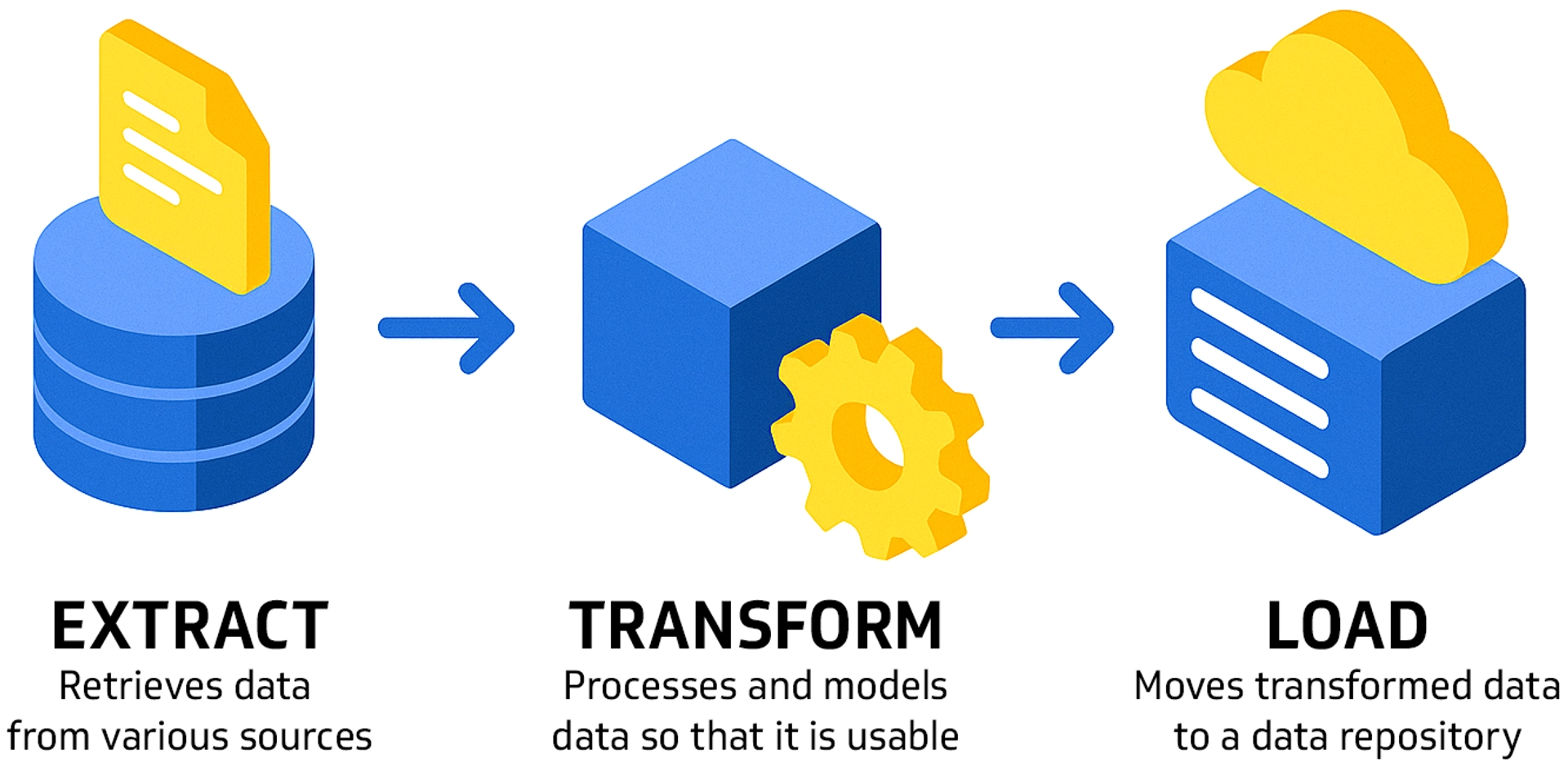
Extract
Extraction is where the process begins. During this phase, your system gathers data from multiple sources. These could be databases, cloud systems, APIs, streaming data sources, or even simple Excel files. The goal is to collect all the raw data spread across different locations in your organisation.
You'll encounter different types of data at this stage. Some data might be structured, like information in a relational database, while others could be unstructured, like emails, documents, or social media feeds. Modern ETL tools help pull together all these different data types, including real-time streaming data from IoT devices or web applications.
Transform
Once data is extracted, it's ready for the transformation phase. This is where data is cleaned, organised, and converted into a useful format for your target system.
You can apply business rules and logic to the data during this phase. You can also perform aggregations, calculations, data validation, and manipulations to derive meaningful insights from information that's now free from errors and inconsistencies.
Modern transformation processes may include data enrichment, where external data sources are integrated to enhance the original dataset, and the application of machine learning algorithms for data quality improvement and anomaly detection.
Load
The final step in the ETL process is loading the transformed data into a target system. This target system could be a database, a data warehouse, a data lake, or any other storage system your organisation uses for analytics and reporting.
There are different loading strategies available. Some methods involve loading all data at once (full load), while others involve adding only new or changed data to existing datasets (incremental load). The choice depends on business needs, data volumes, and the nature of your data.
For instance, if you have a data warehouse that needs daily updates, you would use incremental loading to add new data to existing records. Conversely, if you're setting up a new database or performing a complete refresh, you would use full loading to populate the entire dataset.
Once data is loaded, your team can access and use it to generate reports, feed it into business intelligence tools for analysis, or support real-time dashboards and applications.
Automate
After loading data to its destination, you can enhance your organisation's ETL process by automating various tasks. Doing so makes your process more efficient while reducing errors and ensuring consistency across your data pipeline.
You can automate the entire process from start to finish using scripts, workflow automation tools, or cloud-based orchestration platforms. This includes scheduling data extraction, transformation, and loading tasks to run at specific times, intervals, or triggered by specific events.
Modern ETL tools are evolving to meet demands for real-time integration, no-code accessibility, and advanced automation, enabling organisations to build sophisticated data workflows without extensive technical expertise.
As a result, you and your team can focus on more strategic initiatives while ensuring your data processes run reliably and efficiently.
Monitor
Beyond making your data integration more efficient, automation enables comprehensive monitoring capabilities. While you still need oversight of the ETL process, automated monitoring provides a more proactive approach to managing your data pipeline.
Automated monitoring allows you to track the progress of your ETL jobs in real time. You can set up alerts and notifications to inform you of any issues, failures, or performance degradation during the extraction, transformation, or loading phases.
This step is important because it enables you to take corrective action before problems worsen and affect your data's accuracy and timeliness. Monitoring also helps you identify trends and patterns in your data processing over time, which can inform capacity planning and improvement efforts for your business.
ETL tools
Having the right ETL tools makes your data integration system more efficient and effective. Different tools handle various aspects of the process, and the landscape has evolved significantly with cloud-native and AI-powered solutions.
From extracting data from various sources to loading it into databases or data warehouses, here are the key types of ETL tools you should consider:
Data extraction tools
Data extraction tools use various methods to pull data from different sources. Web scraping software collects data from websites by parsing web pages and extracting relevant information. Database connectors link directly to databases and retrieve data from tables or through queries.
API integrators interact with application programming interfaces (APIs) to retrieve information from web services, cloud applications, and SaaS platforms. Modern extraction tools also support real-time streaming data sources for continuous data ingestion.
Talend remains a popular choice for many organisations with its ability to handle a wide variety of data formats and sources. Its user-friendly interface makes it accessible even for those without extensive technical backgrounds.
Informatica continues to be a top choice, known for its robust performance and strong data integration capabilities. What makes this tool stand out is its reliability in handling complex data transformations and its ability to scale for enterprise-level data integration needs.
Data transformation tools
Your chosen data transformation tool must be capable of handling all the steps needed to convert data to the right format. It should be able to carry out data manipulations, aggregations, filtering, and complex business logic applications.
Many companies use IBM DataStage because of its powerful processing capabilities. It's particularly effective at transforming large amounts of data quickly through scalable parallel processing architectures.
Qlik is an excellent alternative. Its self-service model empowers users, even those without extensive technical backgrounds, to interact directly with raw data, apply business logic, aggregate, and make transformations intuitively. Its drag-and-drop interface allows for easy use while featuring powerful scripting capabilities for advanced users.


Data loading tools
Loading tools should efficiently transfer data into your target system. These tools should provide options for both full load and incremental load operations, enabling you to perform these processes based on your specific requirements.
Oracle Data Integrator (ODI) is a widely-used data loading tool known for its ability to load large volumes of data quickly and efficiently into Oracle databases or data warehouses. ODI also provides built-in data quality and validation features to ensure loaded data remains accurate and reliable.
SAP Data Services is another commonly used tool. One of its key benefits is data profiling capabilities, which help you understand the quality and structure of your data before loading. It also offers strong integration capabilities with SAP products and other enterprise databases.
Integrated ETL platforms
For comprehensive solutions, you can opt for integrated ETL platforms that cover all stages of the process. Modern platforms like Azure Data Factory, Matillion, Fivetran, and Airbyte offer cloud-native pipelines with scalable orchestration and growing AI capabilities.
Azure Data Factory enables seamless integration with various data sources, whether from on-premises databases, cloud data stores like Azure SQL Database and Azure Blob Storage, or third-party services.
Databricks, built on Apache Spark, offers powerful performance in processing large data volumes through distributed computing. Apache Spark is widely used for ETL processes, where data is extracted from various sources, transformed to fit the desired format, and loaded into a data warehouse or data lake. It uses native integration with machine learning and AI capabilities, allowing you to apply advanced analytical models directly within the ETL pipeline.
How MCP servers are beginning to influence ETL
The Model Context Protocol (MCP) is an emerging standard that allows AI systems to connect securely to external data sources and tools. While still early in adoption, MCP is starting to shape how teams think about data movement and transformation — particularly for organisations already using AI agents in their workflows.
Traditional ETL pipelines are deterministic: you define the logic once, schedule the jobs, and monitor for failures. MCP introduces a different possibility. Instead of a static pipeline, an AI agent can query a data source directly, retrieve what it needs, and act on it — without a pre-built extraction script for every source.
This matters for ETL in a few specific ways:
- Agentic orchestration: An AI agent can be prompted to pull data from a source system and load it into a target, translating the intent into the necessary API calls. This reduces the overhead of writing and maintaining custom connectors for every integration.
- Federated access over movement: Rather than extracting everything into a central repository, MCP-enabled agents can query data where it lives and serve insights on demand. This doesn't replace traditional ETL, but it does offer an alternative for certain use cases where moving data isn't necessary.
- Dynamic transformation logic: Traditional ETL relies on static transformation scripts. With MCP, language models can evaluate and apply transformation logic based on context — useful when data structures change frequently or when requirements vary by user.
- Self-healing pipelines: When a schema change breaks a transformation, an AI agent can inspect the new structure, rewrite the logic, and redeploy — reducing the manual effort required to maintain pipelines over time.
That said, MCP doesn't eliminate the need for structured, governed ETL. The value of a well-designed ETL process has always been rooted in trust: data arrives at its destination clean, consistently defined, and verifiable. That doesn't change with agentic approaches. If anything, it becomes more important.
When an AI agent makes decisions based on data — or when a metric surfaces in a dashboard or an AI assistant — the underlying data needs to be trustworthy. Poorly defined, inconsistently transformed data produces unreliable outputs, whether the pipeline is a scheduled batch job or an AI-driven workflow. Governance, lineage, and clear metric definitions remain essential regardless of how data moves.
MCP is best understood as a complement to ETL, not a replacement. For exploratory queries, rapid prototyping, and AI-assisted workflows, it offers real flexibility. For critical, governed data processes where consistency and auditability matter, structured ETL pipelines remain the right foundation.
Difference between ETL and ELT
ETL and ELT (Extract, Load, Transform) are two different approaches to similar processes. Both should be considered when deciding how your business should handle data assets.
Core process
Although it might seem like a minor difference, changing the order of the last two steps — transformation and loading — has significant implications for the application and effectiveness of these processes.
With ETL, the approach involves modifying the data's format first, then loading it into the destination. This means data is refined and ready for use once it enters the data warehouse. It's methodical and allows for a high degree of control over data quality and structure.
In ELT, transformation happens after data is stored. This approach uses the processing power of modern cloud data warehouses, enabling you to handle larger data volumes more efficiently and with greater flexibility.
Data transformation
ETL requires a separate staging area for transformation. Although this adds complexity to the process, it allows for intricate processing, which is excellent for maintaining consistent data quality and format before data reaches its final destination.
Meanwhile, data transformation happens within the data warehouse for ELT. This approach is more efficient and adaptable, especially when dealing with large, unstructured, or semi-structured datasets. This approach works best for organisations with diverse data ecosystems and evolving analytical requirements.
Performance and speed
The pre-loading transformation step in ETL can be time-consuming, making it better suited for scenarios where data volume is manageable and processing time is less critical than data quality.
For instance, you might choose ETL when generating regulatory reports and compliance analysis, where you can allocate sufficient time for thorough transformation processes. It also allows for precise control over data quality and structure, which is valuable when working with sensitive or critical data.
ELT often results in faster performance, especially when integrated with modern cloud-based data warehouses. You'll want to choose this approach if you're dealing with real-time data requirements or high-volume transactional data that needs to be quickly available for analysis.
Scalability and flexibility
Traditional ETL approaches may face challenges when handling very large data volumes due to processing limitations in the transformation layer. However, modern ETL has evolved significantly with AI-powered automation and cloud-native architectures that can handle massive datasets effectively.
For maximum scalability and flexibility, the ELT model becomes even more powerful when used with cloud-native data warehouses. If your organisation is experiencing rapid growth or has unpredictable data volumes, you'll find ELT more adaptable and responsive to changing requirements.
Complexity and maintenance
ETL requires more technical expertise to set up and maintain, particularly with traditional on-premises implementations. You'll need dedicated teams and resources to manage multiple systems and ensure their integration.
With ELT, you get a more streamlined system because it primarily uses your data warehouse's capabilities. Businesses with limited IT resources often find ELT more manageable and cost-effective, especially when using cloud-based solutions.
Data storage and warehousing requirements
Traditional ETL needs separate transformation infrastructure, which means additional hardware, software, and management overhead. This can become costly and require more resources for maintenance.
In contrast, ELT can operate using modern data warehouse architecture. With today's cloud-based warehousing solutions, you can easily adapt your approach to accommodate changing storage and processing needs without building additional transformation infrastructure, whether you opt for a data lake, data warehouse, or hybrid approach.
ETL vs. ELT: Which should you choose?
With ELT being faster and more scalable in many scenarios, it might seem like all organisations should adopt it. However, ETL's main benefit is providing a high degree of control over data quality and structure. That's why many finance and healthcare companies prefer it, as they can maintain strict compliance and ensure data accuracy throughout the process.
ELT is well suited for businesses that deal with large volumes of unstructured data. Technology companies, for instance, must collect and analyse huge amounts of data from social media, customer interactions, and sensor data. The growing complexity of data and demand for real-time insights have accelerated the evolution of traditional ETL processes.
E-commerce platforms represent another industry that benefits significantly from ELT, as they need to use big data for analytics. They often have diverse data ecosystems and can benefit most from the scalability and flexibility that ELT provides.
Choosing between ETL and ELT depends on your organisation's specific needs and priorities. You'll need to consider factors such as data volume, speed requirements, scalability needs, complexity tolerance, maintenance capabilities, and storage requirements. This way, you can choose the best approach for your data integration needs.
Many modern organisations are adopting hybrid approaches, using ETL for critical, governed data processes and ELT for exploratory analytics and rapid prototyping.
Final thoughts
ETL offers more control over data quality and structure, which is essential when handling sensitive or critical information. This methodical approach allows for precise processing, although it may affect speed and performance in some scenarios.
If you prioritise performance and scalability, modern cloud-based ETL or ELT solutions can both deliver strong results. The evolution toward AI-powered automation, real-time integration, and no-code accessibility is transforming how organisations approach data integration. Emerging approaches like MCP-enabled agentic workflows add further flexibility — but they work best when built on a foundation of well-governed, consistently defined data.
Ultimately, the goal is to manage and use data effectively for strategic business growth, whether through traditional ETL, modern ELT, or hybrid approaches that combine the best of both.
FAQ
Is SQL an ETL tool?
Structured Query Language (SQL) isn't an ETL tool by itself, but rather a language used to manage and manipulate databases. However, it plays a important role in ETL processes, particularly in the extraction and loading phases.
With SQL, you can query and extract data from databases efficiently. You can also use it to load transformed data back into database systems and perform certain transformation operations directly within the database.
Many ETL tools integrate SQL capabilities to complete data extraction and loading processes. For instance, you might write SQL queries to pull data from a source database and use an ETL tool's transformation engine to process this data before loading it into your target system.
Can Python be used for ETL?
Yes, Python is widely used for ETL processes and has become increasingly popular in the data engineering community. Its extensive library ecosystem, including Pandas, NumPy, SQLAlchemy, and Apache Airflow, makes it an excellent choice for extraction, transformation, and loading operations.
One of the key benefits of using Python for ETL is its flexibility and ease of handling complex data transformations. You can connect Python scripts to various data sources, apply sophisticated business logic during the transformation phase, and load data into multiple target systems. Python can help organisations automate and streamline their ETL processes while providing extensive customisation capabilities.
Python's integration with Apache Spark also enables large-scale ETL processing, making it suitable for big data environments.
Is coding required for ETL testing?
While coding knowledge can be beneficial, especially for complex test scenarios, many ETL testing tasks can be performed using specialised no-code tools and platforms.
Modern ETL tools are evolving toward no-code accessibility, allowing business users to create and test data pipelines without extensive programming knowledge. Tools like Informatica, Talend, or SQL Server Integration Services (SSIS) have user-friendly interfaces and features that allow you to create test cases, execute tests, validate data transformations, and monitor load processes through point-and-click functionality.
However, coding skills become valuable when dealing with complex data transformations, custom business logic, or specialised testing scenarios. SQL and Python are two of the most commonly used languages in ETL environments.
SQL is typically used for data querying, validation, and manipulation, while Python is used for more complex transformations, custom testing frameworks, and automation scripts.
Effective ETL testing should balance automated testing tools with manual coding when necessary. Automated tools can handle routine tests and data comparisons efficiently, while coding skills enable more sophisticated testing for customised ETL processes, debugging complex issues, and maintaining the highest levels of data quality and process accuracy.
How does MCP relate to traditional ETL pipelines?
MCP (Model Context Protocol) is an emerging standard that lets AI agents connect to data sources and tools directly. Rather than replacing ETL, MCP complements it by enabling more dynamic, on-demand data access for AI-driven workflows.
Traditional ETL remains the right choice when data quality, governance, and auditability are priorities. MCP-based approaches are better suited to exploratory queries and agentic workflows where flexibility matters more than strict consistency. The two can coexist — and in many organisations, they will.