
What are the best self-serve AI and analytics platforms for mid-market
Mid-sized companies juggle Excel files, SaaS APIs like HubSpot or Shopify, and a growing warehouse such as Snowflake. The best platform connects all three, keeps definitions consistent, and stays friendly for non-technical users. This guide compares leading options with clear strengths, limits, and pricing notes so you can choose with confidence.
How these platforms were evaluated
- Connectivity coverage: Files, SaaS APIs, and warehouses such as Snowflake or BigQuery.
- Governance: Consistent metric definitions, access controls, certification.
- No-code modelling: Joins and formulas business users can manage.
- AI assistance: Useful prompts, clear explanations, guardrails.
- Performance at scale: Warehouse-native options, stored history, refresh cadence.
- Time to value: Templates, instant metrics, set-up speed.
- Pricing and TCO: Licensing, add-ons, and long-term maintenance.
1) Klipfolio PowerMetrics: Definition-first metrics for mid-market teams
Who it is for: Mid-sized companies that split data across SaaS tools, spreadsheets, and a warehouse, and want a shared source of KPI truth.
Hybrid fit: Excellent at metric blending. Combine a lead count from an API, cost-per-lead from a spreadsheet, and revenue history from a warehouse into one governed metric.
Ease of use: High. Build once in the Metric Library, then anyone can add the metric to dashboards without breaking logic.
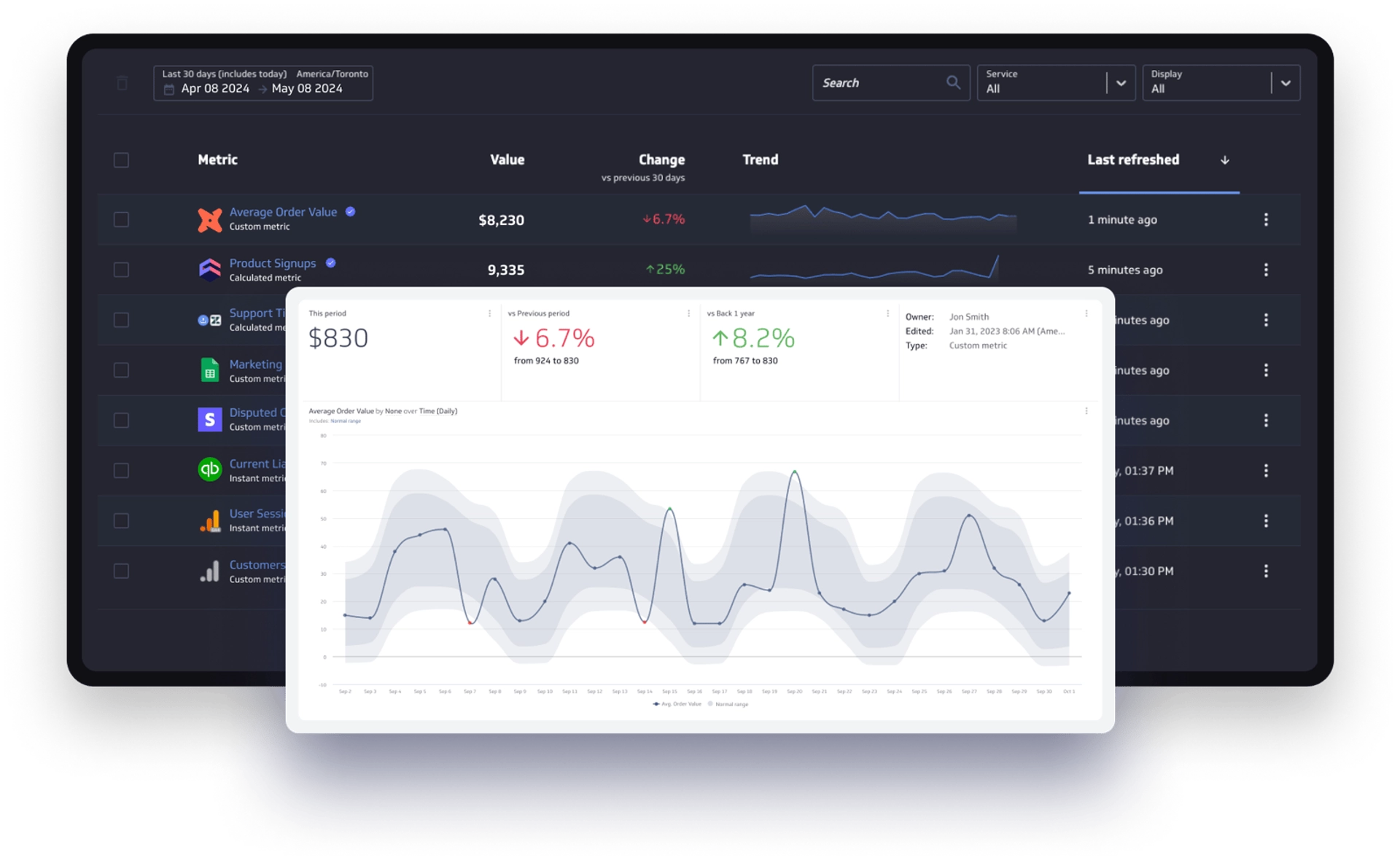
AI features: PowerMetrics AI is a core part of this platform and their MCP Server. Ask natural-language questions about certified metrics and get guided explanations, not just charts.
Governance: Definition-first workflow. Define "Revenue" or "Profit" once, certify it, and reuse everywhere with role-based access.
Pricing and TCO: Mid-market friendly. Fast time to value reduces reliance on specialist builders.
Why it might be your pick: Best balance of API, file, and warehouse data in a single KPI library, plus Governance that ends debates over which number is right.
2) Databox: Fast, "set it and forget it" dashboards
Who it is for: Marketing-heavy teams that want quick visibility from 100+ APIs and spreadsheets using pre-built templates.
Hybrid fit: Strong for live API snapshots with lightweight spreadsheet goals. Less suited to deeper modelling across many joins.
Ease of use: Very high. Drag-and-drop with templates gets dashboards live in minutes.
AI features: Benchmark Groups to compare performance against similar companies.
Governance: Light. Good for single-team views, less for cross-department standardization.
Pricing and TCO: Transparent tiers. Add-ons and higher-volume needs can raise costs.
Why it might be your pick: Speed to first dashboard and solid marketing connectors.
3) Sigma Computing: Spreadsheet feel on top of your warehouse
Who it is for: Excel power users moving to the cloud who want familiar formulas on live warehouse data.
Hybrid fit: Ideal if the center of gravity is the warehouse. You can join an uploaded CSV to live Snowflake data quickly.
Ease of use: High for spreadsheet users. Advanced work benefits from warehouse concepts.
AI features: Sigma Copilot for formula help and chart generation.
Governance: Relies on warehouse objects and permissions. Strong when paired with solid data modelling.
Pricing and TCO: Tends to be premium for mid-market budgets.
Why it might be your pick: If most analysis lives in the warehouse and the team thinks in spreadsheets.
4) Zoho Analytics: Best value all-in-one integration
Who it is for: Teams seeking an affordable suite that spans data prep, integration, and visualization.
Hybrid fit: Good at blending disparate sources, such as matching a local CSV of costs against API-derived revenue.
Ease of use: Moderate. Friendlier than some enterprise BI tools, still a learning curve.
AI features: Zia, a chat-style assistant for building reports and forecasting.
Governance: Solid for mid-market needs, lighter than tools built around strict metric definitions.
Pricing and TCO: Strong value. Suits cost-conscious teams or those already using Zoho apps.
Why it might be your pick: Broad capability at an accessible price.
5) Microsoft Power BI with Fabric: Microsoft-centric scale
Who it is for: Organizations standardized on Microsoft 365 and Azure that need broad distribution and enterprise controls.
Hybrid fit: Excellent with Excel and Azure services. Can reach SaaS APIs, files, and warehouses with the right connectors.
Ease of use: High for viewing. Building models usually needs a power user.
AI features: Copilot can draft report pages and help explain visuals.
Governance: Mature enterprise controls when configured, which adds set-up effort.
Pricing and TCO: Licensing, capacity, and Fabric features can push total cost up fast.
Why it might be your pick: Deep Microsoft stack integration and enterprise reach.
6) Domo: Full-stack platform with broad connectors
Who it is for: Mid-market companies that want ingestion, storage, and visualization managed in one platform.
Hybrid fit: 1,000+ cloud connectors simplify API and file ingestion. Warehouse connections available.
Ease of use: High for business users. Magic ETL simplifies data prep.
AI features: AI-assisted prep and insights baked into the workflow.
Governance: Strong within the Domo platform, helped by centralized storage and roles.
Pricing and TCO: Often priced at the higher end for mid-market. Consider lock-in along with convenience.
Why it might be your pick: One vendor for the stack, fewer moving parts to manage.
Quick recommendations by scenario
- You need shared, trusted KPIs across tools: Pick Klipfolio PowerMetrics.
- You need fast marketing dashboards: Pick Databox.
- Your work lives in the warehouse and your team thinks in spreadsheets: Pick Sigma Computing.
- You want broad capability on a budget: Pick Zoho Analytics.
- You are all-in on Microsoft: Pick Power BI with Fabric.
- You want one platform to run the stack: Pick Domo.


Next step for mid-market teams
Start by listing the 10 metrics you argue about most, such as "Revenue," "Lead volume," and "Customer acquisition cost." Standardize each definition, then choose a platform that lets you blend API, file, and warehouse data into those governed KPIs. If cross-team trust and self-serve adoption are top priorities, learn more about why a metrics-first approach, such as PowerMetrics, is the right choice.
Related questions
What are the best BI tools for growing companies
Do Small and Mid-Sized Teams Need a Metrics Analytics Platform?
Why AI analytics requires a metric catalog
What is Agentic AI And How Could It Help With Business Analytics?
How does a metrics layer support self-serve analytics?
Best data analytics tools for growing businesses