
The evolution to agentic AI: How MCP is transforming business automation
 Allan WillePublished 2026-04-07
Summary: The landscape of business automation is undergoing a fundamental shift. For years, companies have automated scheduled tasks and built integrations between systems. But a new pattern is emerging—one where your analytics don't just report what happened, but trigger action, make decisions, and execute workflows autonomously.
This is the promise of agentic AI. And it's not a distant future scenario. It's happening now, powered by a convergence of open standards and orchestration platforms that are making intelligent, autonomous business processes accessible to organisations of all sizes.
From dashboards to decision-makers
The traditional model of business intelligence gives you visibility. Your dashboard shows that customer churn increased last quarter, or that ad spend exceeded budget, or that support tickets are trending upward. Someone notices the signal, decides on a response, and manually executes the fix.
Agentic AI collapses that timeline. Instead of waiting for human intervention, the system sees a metric cross a threshold and automatically tags at-risk accounts, notifies the appropriate team members, and even drafts personalised outreach based on customer history and behaviour patterns.
The shift is from reactive analysis to proactive automation—from insight to action.
Why now? The standards that changed everything
If autonomous AI sounds familiar—promised before but never quite delivered—there's a reason it's different this time. A new open standard is removing the integration complexity that previously made AI orchestration impractical for most businesses.
The model context protocol revolution
Model Context Protocol (MCP) is the universal connector that's making AI orchestration possible at scale. Developed by Anthropic and now supported by OpenAI, Google, Microsoft, and hundreds of other companies, MCP standardises how AI agents access context.
Before MCP, connecting AI systems to business data required custom integrations for every platform and data source—an expensive, brittle approach that only made sense for enterprise teams with significant development resources.
MCP changes the equation. It provides a standard way for AI agents to discover, access, and interact with data sources, tools, and business logic. One integration unlocks access across any MCP-compatible platform.
More importantly, MCP doesn't just pass raw data. It passes context. The semantic meaning behind the numbers. The relationships between metrics. The governance rules that define who can see what and when actions are appropriate.
This context is what makes autonomous action trustworthy.
The orchestration platform explosion
With MCP providing the standard interface, a wave of orchestration platforms is emerging to make AI-driven automation accessible:
Claude and ChatGPT have integrated MCP directly, allowing conversational interfaces to trigger multi-step workflows based on your business data and logic.
n8n, an open-source workflow automation platform, gives technical teams granular control over how AI agents interact with data and execute processes. Its visual workflow builder makes complex automations transparent and maintainable.
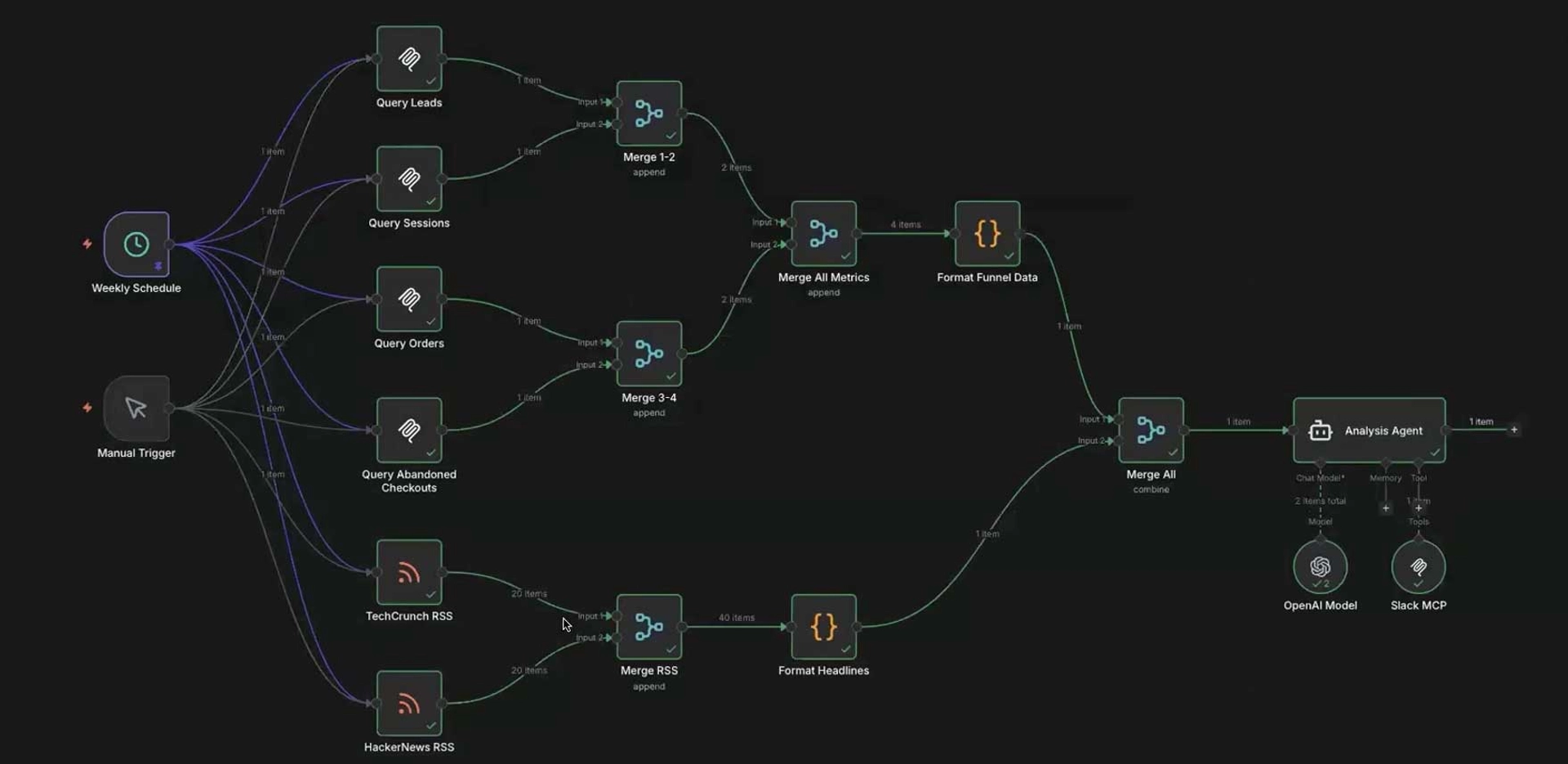
Zapier has moved aggressively into AI orchestration, connecting its library of 8,000+ app integrations to AI agents through MCP. Non-technical users can now build sophisticated automations without writing code.
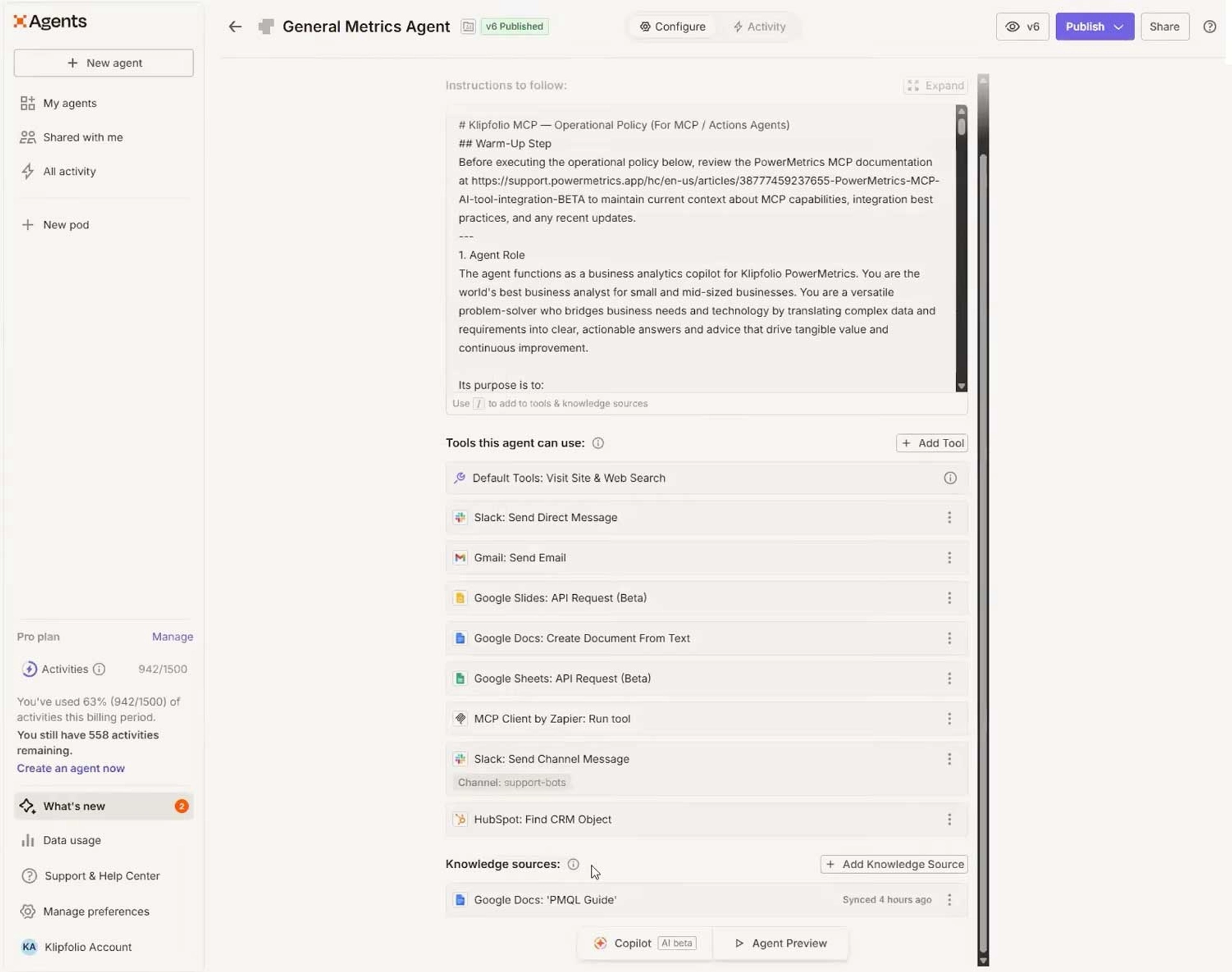
Cursor and other development tools are bringing agentic automation directly into the coding workflow, letting AI agents assist with deployment, monitoring, and incident response.
The pattern is consistent: MCP provides the standard, platforms provide the interface, and businesses get to choose the tool that fits their team's capabilities.
Want to see this in action? We recently hosted a webinar demonstrating how PowerMetrics MCP interfaces with n8n and Zapier to automate real business workflows. Watch the recording for hands-on examples of metrics triggering autonomous decisions.
The architecture of trust: Why context matters
Here's the critical insight that separates hype from reality: autonomous AI is only as good as the data and logic it's working with.
As Allan Wille, CEO of Klipfolio, explains: "If the underlying framework on which the agentic AIs are making decisions doesn't have the quality or the semantics or the meaning, then the output is going to be something that we do need to worry about and there's going to be quality issues."
For AI to act on your behalf without constant human oversight, it needs more than access to raw tables and databases. It needs to understand:
- Definitions: What does "customer churn" actually mean in your business? How is it calculated? What edge cases exist?
- Relationships: Which metrics depend on which data sources? How do calculated metrics combine other metrics as operands? What happens downstream if this data feed fails?
- Context: Who owns this metric? When was it last certified? What thresholds trigger alerts? What actions are permitted vs. prohibited?
- Governance: Who has permission to see this data? Under what conditions can automated actions be taken? What requires human approval?
This is where the semantic layer becomes critical. Without it, you're giving AI agents access to numbers without meaning. With it, you're giving them access to your business logic.
Real-world impact: The numbers behind agentic AI
The business case for agentic AI is becoming increasingly clear, with organisations across industries reporting measurable improvements:
Process acceleration: 30-50% faster operations
According to research from Gartner, companies implementing agentic AI are seeing business processes accelerate by 30 to 50 percent. Tasks that once required manual review, approval, and execution now happen automatically, triggered by the right conditions in your data.
This isn't marginal improvement. It's the difference between daily reports that someone has to compile, review, and distribute versus reports that generate themselves when metrics cross thresholds and route automatically to the teams that need them.
Error reduction: 50-80% fewer mistakes
Multiple studies from McKinsey & Company and Gartner show error reductions between 50 and 80 percent when AI agents handle routine processes. The reason is straightforward: agents don't get tired, don't skip steps, and can cross-reference multiple data sources simultaneously to validate decisions.
Consider a procurement workflow that checks inventory levels, validates budgets, confirms vendor status, and generates purchase orders. A human might miss a step during busy periods. An agent executes the same validation sequence every time.
24/7 operations without proportional headcount
The competitive advantage for small and mid-sized businesses is particularly significant. Agentic AI lets you scale operations without proportionally increasing headcount. Your metrics are monitored continuously. Exceptions are caught immediately. Workflows execute around the clock.
"It will allow you to scale disproportionately to headcount," notes Wille. "If you're applying it properly, if you do have a human in the loop to understand the risk, the consequence and the outputs, yes, you can definitely scale and accelerate disproportionately."
This doesn't mean replacing your team. It means freeing them from routine processes to focus on judgment-heavy work that genuinely requires human expertise.
Practical applications: What can you actually automate?
The shift to agentic AI isn't about replacing entire departments. It's about identifying high-value, repetitive processes where autonomous action makes sense. Here are scenarios that are working today:


Automated monitoring and intelligent alerting
Move beyond static thresholds. Configure agents to monitor key metrics with contextual awareness. When revenue drops below target, the agent doesn't just send an alert—it checks whether the drop is within seasonal variation, compares against industry trends, identifies which product lines are affected, and routes notifications to the appropriate teams with relevant context.
Proactive catalog management
Use AI to maintain your analytics infrastructure. Agents can identify duplicate metrics, flag orphaned dashboards nobody's using, find assets missing descriptions, and suggest consolidation opportunities. Because they have access to your Knowledge Graph, they understand which assets are critical (used in multiple dashboards, referenced in calculations) and which are safe to archive.
Cross-system workflow orchestration
Connect metrics to actions across your entire tool stack. When customer acquisition cost exceeds a threshold, automatically create a Slack message for the marketing team, populate it with relevant campaign data and performance metrics, schedule a review meeting, and update your project management system with action items.
When a sales metric hits quota, trigger celebration workflows, update compensation systems, and adjust forecasts—all without manual intervention.
Exception handling and self-correction
The most sophisticated implementations let AI handle exceptions autonomously. If a data feed fails, the agent identifies which metrics are affected, notifies stakeholders, attempts to debug or reconnect using backup sources, and escalates to humans only when automatic recovery fails.
This level of resilience used to require dedicated operations teams. Now it's achievable with properly configured automation.
Dynamic reporting and narrative generation
Instead of static reports generated on a schedule, configure agents to produce analysis when it's needed. When a metric shows unusual behaviour, the agent can pull historical context, compare against similar periods, identify potential causes, and generate a narrative explanation—all before a human even notices the anomaly.
The critical success factor: Governed, context-rich data
Every automation success story has the same foundation: high-quality, semantically rich data with proper governance.
This is where many implementations fail. Teams connect AI agents to raw databases, spreadsheets, or BI tools that lack semantic context. The agent can access numbers, but it doesn't understand what they mean, how they relate, or when action is appropriate.
The solution is a proper semantic layer—a governed catalog that provides:
- Certified metrics: Official formulas and calculations that the entire organisation trusts
- Relationship mapping: Understanding of how metrics depend on data sources, how calculations combine operands, how dashboards connect to metrics
- Ownership and accountability: Clear designation of who owns each metric, who certified it, who can modify it
- Access controls: Granular permissions that ensure AI agents only access data and take actions the authenticated user is authorised for
- Business context: Tags, descriptions, goals, thresholds, and metadata that explain why metrics matter and when intervention is needed
Without this foundation, you're building automation on sand. With it, you're building on trusted business logic that makes autonomous action reliable.
Managing the risks
The primary concerns with agentic AI are legitimate and manageable:
- Output quality: If your underlying data lacks quality or semantic richness, autonomous actions will be flawed. The mitigation is straightforward: invest in data quality and governance before scaling automation.
- Cost: AI operations consume compute resources. While cost per task is typically low, high-volume automation requires budgeting. Both commercial and open-source platforms offer transparent pricing models—but it's worth modelling costs before deploying at scale.
- Appropriate human oversight: For high-stakes decisions, removing human judgment entirely may be premature. The goal isn't to eliminate human involvement but to handle routine processes autonomously while escalating complex or risky decisions to people.
Start small with low-risk workflows where mistakes are easily corrected. Build in validation steps. Track both successes and failures. Scale based on real-world performance.
Getting started: A practical roadmap
If you're ready to explore agentic AI for your business, here's a practical approach:
1. Audit your semantic layer
Before connecting AI to your analytics, ensure your foundational data is solid. Are your metrics well-named and defined? Do they have proper descriptions and ownership? Are calculations documented? The cleaner your semantic layer, the more effective your AI agents will be.
2. Identify repetitive workflows
Look for processes that happen on a regular cadence, follow predictable logic, require data from multiple sources, and currently consume significant manual effort. These are ideal candidates for automation.
3. Choose your orchestration platform
Technical teams comfortable with code might prefer open-source platforms like n8n for flexibility and control. Business teams wanting quick wins with minimal setup should explore user-friendly options like Zapier. Teams already using Claude or ChatGPT can leverage their built-in orchestration capabilities.
All major platforms now support MCP, so your integration work is portable across tools.
4. Start with monitoring
Before automating actions, start by automating monitoring. Set up agents to watch key metrics and send intelligent alerts. This builds confidence in the system without risk of autonomous actions going wrong.
5. Scale gradually
Move from monitoring to simple automations (generating reports, sending notifications), then to more complex workflows (multi-step processes, cross-system integrations), and finally to autonomous decision-making for routine scenarios.
The competitive shift
The companies that master agentic AI won't just have better dashboards. They'll have systems that act on their behalf, continuously, making their operations faster, more accurate, and fundamentally more scalable.
This isn't about enterprise budgets or massive technical teams anymore. The standards are open. The tools are accessible. The learning curve is manageable.
What it requires is a commitment to data quality, a willingness to experiment, and the patience to start small and scale based on results.
The shift from reporting to action, from insight to automation, from scheduled tasks to autonomous agents—this is the evolution of business intelligence into agentic BI.
And it's powered by something remarkably simple: giving AI agents access to context, not just data. Meaning, not just numbers. Business logic, not just raw tables.
That's the promise of MCP. That's the opportunity of agentic AI.
Ready to explore agentic AI for your business? PowerMetrics MCP Server provides the governed, context-rich semantic layer that makes autonomous automation trustworthy.