
Our metric-centric product vision – Business Intelligence ahead of its time

 Allan WillePublished 2023-06-21
Summary: PowerMetrics is the first metric-centric analytics solution, redefining how organisations approach business intelligence. Launched in 2018, it moved beyond traditional warehouse-centric BI to embrace a future where data has meaning, governance is rigorous, and business teams can serve themselves. This is the story of how we pioneered the metrics layer and why the world is finally ready.
Moving beyond the warehouse-centric stack
There is a fundamental shift occurring in business intelligence. Organisations are moving away from the traditional model—where data is dumped into a warehouse and "visualised" without context—and embracing a metric-centric vision.
Focused on defined metrics, rigorous governance, and clear lineage, this approach provides the trust and confidence needed to make data-driven decisions at speed. While industry thought leaders have only recently begun to champion the "metrics layer," PowerMetrics has been refining this architecture for nearly a decade.
What is the metrics layer?
The metrics layer is the semantic meaning inserted between raw data and the people using it. Instead of loose, inconsistent naming scattered across silos, metrics are defined once at a global level, abstracted from the source, and shared across your entire organisation.
In a modern data stack, this layer ensures a stable, single source of truth. "Net Profit" isn't just a number—it's an understood business term calculated consistently as Sum(Revenue) - Sum(Expenses), every time, everywhere.
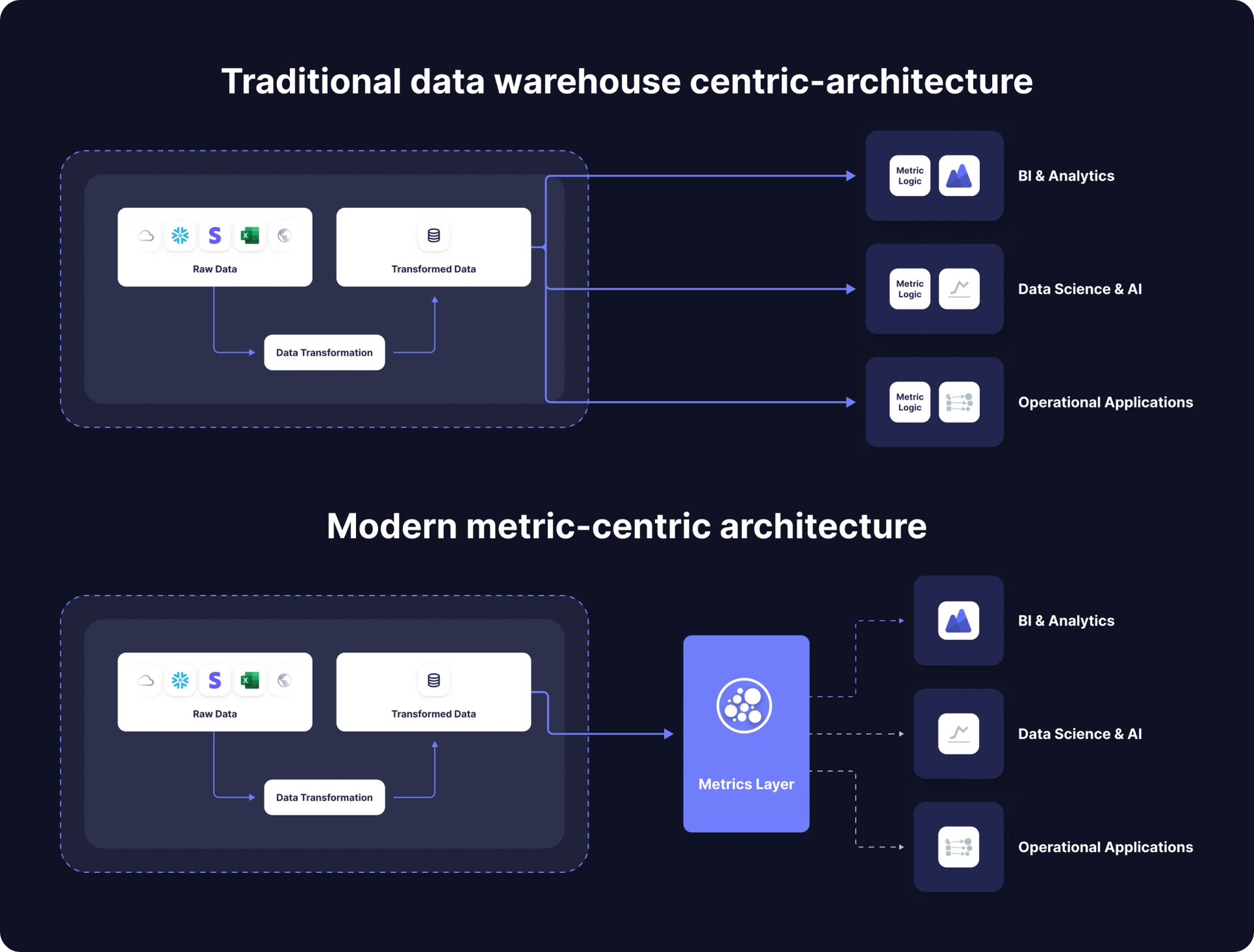
Properly defined metrics stored in a central layer present the first real opportunity for true self-serve data analysis. We call this metric-centric BI. While PowerMetrics pioneered this path, others have since joined the movement: dbt Labs now promotes the dbt Semantic Layer, and Google's Looker launched Looker Modeler to solve these same consistency challenges.
Why we rethought BI five years ago
To understand our vision, you have to understand our history. In 2012, we launched Klips—a revolutionary, flexible product that connected directly to cloud services and performed transformations in real time at the visualisation layer.
Klips was powerful, but it had a steep learning curve. As our customers matured, they told us that managing "raw" data was becoming an overwhelming challenge. They could access plenty of information, but it lacked context. Things got messy, fast—like having a thousand sticky notes without a filing system.
Data needs to have meaning
As data grew, customers struggled to manage thousands of individual assets. We realised the future was clear: Data must have meaning. This led us to the concept of the metric—a business-defined, consistently calculated, universally understood number.
All metrics should have business definitions, a shared catalog of dimensions, and consistent time grains. We shifted our focus from "dashboards" to "opinionated metrics"—the solution to a world where data was noisy and directionless.
Analytics must be self-serve
In traditional BI, business teams (Marketing, Sales, Finance) have had to wait on technical teams to "prepare" data. This creates an endless feedback loop of requests and revisions that frustrates everyone.
Our vision was a "buffet" of metrics: a world where a business leader could walk up to a prepared set of centrally defined KPIs and serve themselves. However, we noticed that even the best self-serve tools required a "data person" to ensure accuracy. This sparked our CTO's realisation in 2018:
- Users often don't know how a metric is calculated or what action to take
- Without semantic meaning, there are no "network effects"—you can't easily compare your performance against benchmarks or see relationships between different parts of the business
PowerMetrics: A metric-centric architecture
We decided to build PowerMetrics from the ground up, making the Metric a first-class citizen. Our architecture is defined by two core ideas:
Semantic meaning: Data becomes meaningful only when business logic is applied. A metric is not just a calculation—it's a defined, auditable business concept that everyone understands the same way.
Time as the universal dimension: Almost every business question involves time. We built PowerMetrics to handle snapshot, periodic, and transactional data natively, ensuring that every metric is comparable across any time grain.
In 2020, we doubled down on this by launching MetricHQ—the world's first community-driven dictionary for metrics. It allows data and business teams to learn from industry experts and add pre-built metric definitions directly to their accounts.
Why the world wasn't ready for PowerMetrics—until now
Early on, our vision was so ahead of its time that even we struggled to message it correctly. We focused entirely on the end user, who often saw the "metrics layer" as an extra step in the way of their dashboard.
Then came our eureka moment: Trusted data is the common goal. Data teams want governance; business teams want accuracy. When they work together through a metrics layer, the friction disappears. Experience has taught us that working with data engineers and analysts leads to the best outcomes for the executive suite.
Metrics: The language of data and business teams
Today, we see the purpose of the data team and the business team finally aligning. In this new world:
Data teams manage the complex query landscapes and ensure integrity via the metrics layer.
Business teams apply those trusted metrics to their own dashboards and reports in a true self-serve environment.
The metrics are defined once and used everywhere. No more queuing up for IT to build "one more report." No more arguments over why two different spreadsheets show two different versions of the truth.


The future is metric-driven
We are moving beyond the limitations of the old warehouse-centric stack. We are joined by a growing group of believers—leaders from dbt, Mode, and DuckDB—who agree that the future isn't about "Big Data," but about valuable, trustworthy metric data.
The metric-centric approach offers a more efficient workflow, better performance, and superior governance. But most importantly, it empowers people at every level of the organisation to make well-informed decisions with absolute confidence.
Data needs meaning. The future of business intelligence is here, and it's all about metrics.