
Metric-Centric Analytics: What It Is and Why It Matters
 Cathrin SchneiderPublished 2026-01-08
Summary: In the world of business intelligence (BI), we have reached a tipping point. For years, organizations have struggled with the "data gap"—the space between complex data warehouses and the business users who need insights to make decisions.
The traditional approach to analytics has often resulted in a "wild west" of conflicting numbers, where Marketing’s definition of a "lead" doesn't match Sales' definition, and the data team is stuck in an endless loop of building the same dashboard over and over.
Metric-centric analytics changes this. By inserting a governed metrics layer between your data and your users, you create a single, trusted source of truth. This architecture doesn't just benefit human users; it provides the essential foundation for the AI-driven future of 2026. Whether a person is looking at a dashboard or an AI agent is answering a natural language query, they are both pulling from the same defined and trusted metric.
What Is a Metrics Layer?
The metrics layer is a central repository for an organization’s business logic. It is where raw data is transformed into meaningful metrics—like Revenue, Churn, or CAC—using standardized calculations and metadata.
In a traditional BI stack, business logic is often buried inside individual reports or SQL queries. In a metric-centric stack, that logic is pulled out and housed in its own dedicated layer. Once a metric is defined here by data experts, it is ready to be consumed by anyone—or anything—in the organization.
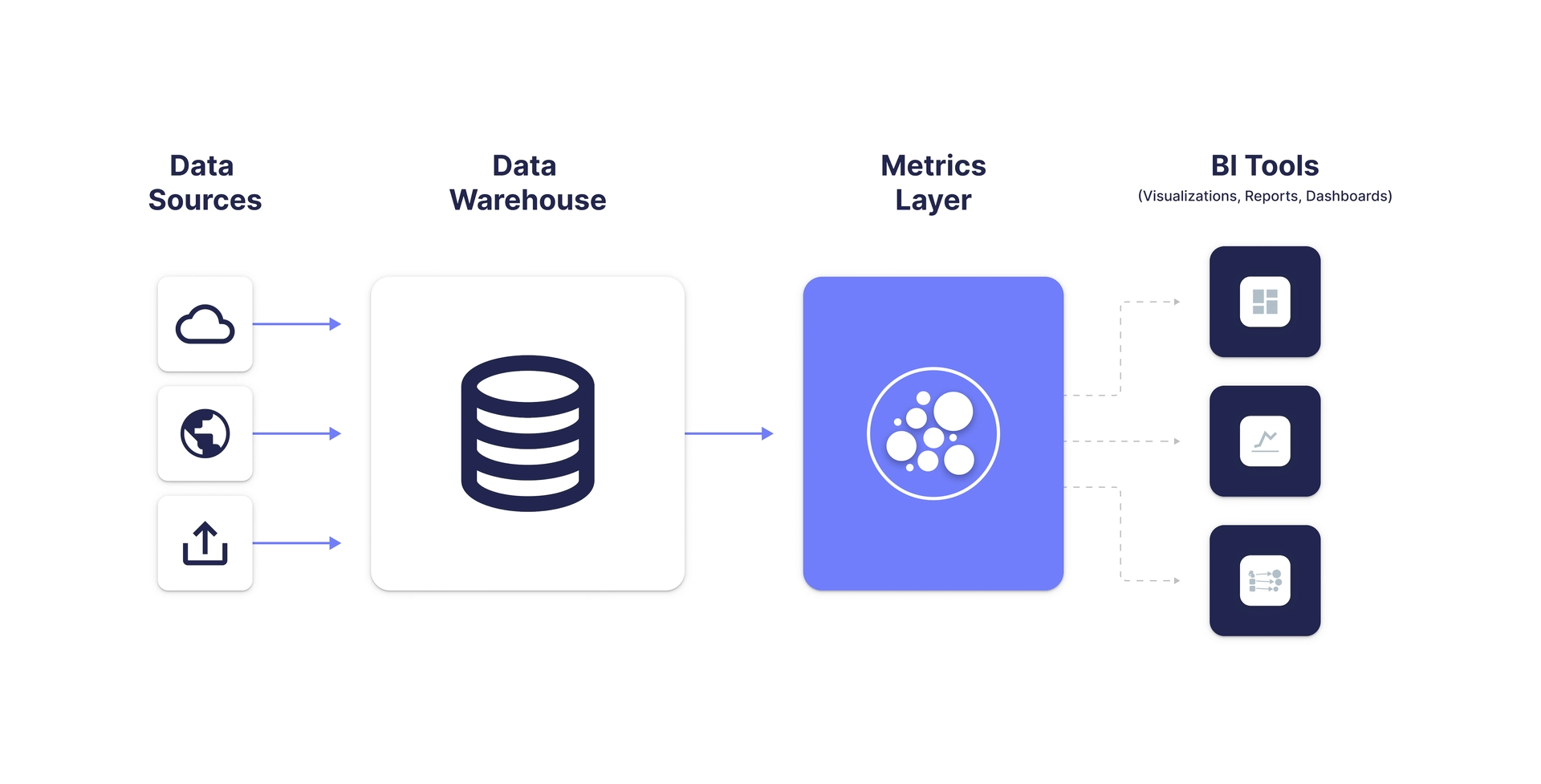
A metrics layer is a separate but integrated layer within the modern data stack:
The Essential Benefits of a Metrics Layer
A metrics layer solves the core challenges of data maturity. It ensures that everyone, regardless of their technical expertise, is speaking the same language. Here is why this shift is foundational to modern business.
1. Metrics are the language of data
Working together, business and data teams create meaningful definitions for their most important KPIs. These are centrally applied in the metrics layer. Once created, data engineers manage the pipeline, and business teams never have to worry about the "math" being wrong. The source data is modelled, the time grain is defined, and the definition is written in plain language. This allows business teams to focus on what they do best: using trusted data to drive the company forward.
2. Single source of truth
In 2026, the "user" isn't always a human. We are increasingly interacting with data through AI-powered chat interfaces and autonomous agents.
- For Humans: It prevents the duplication of metrics and ensures that two different people don't walk into a meeting with two different versions of "Profit."
- For AI: Large Language Models (LLMs) are notorious for "hallucinating" if they are asked to calculate complex data on the fly. A metrics layer provides the AI with a pre-defined, trusted API. Instead of the AI trying to guess how to calculate churn, it simply queries the "Churn" metric from the layer. This ensures the AI's response is as accurate as a certified financial report.
3. Transparency and lineage
With metrics accessible via a central catalog, it is easy for everyone to see the "who, what, and where" of their data. Users can see who owns the metric, how many colleagues are using it, and exactly where the source data originates. This transparency builds a culture of data literacy and trust. If a number looks "off," a user can trace its lineage back to the source without needing a degree in data engineering.


4. Consistency across all endpoints
Because the metrics layer is "headless," the same definition can be used across an endless number of consumption points. Whether you are viewing a metric in a PowerMetrics dashboard, a mobile app, an Excel spreadsheet, or a Slack bot, the data is 100% consistent. This centralized model eliminates the silos that lead to ineffective, fragmented decision-making.
5. Scalability and continuity
As an organization grows, the number of metrics it tracks inevitably increases. A metrics catalog makes it easy to add new KPIs or build "derivative" metrics (metrics built on other metrics) without disrupting existing reports.
Furthermore, the metrics layer provides business continuity. If the underlying data source changes—for example, if you move from one CRM to another—the data team can update the mapping in the metrics layer. To the business user or the AI agent, the "Sales" metric remains the same. The transition is invisible, and the historical data remains intact.
Why Metric-Centric Analytics Surpasses Traditional BI
Many organizations try to "bolt on" a metrics layer to their existing, traditional BI tools. While this is a step in the right direction, it lacks the elegance and efficiency of a purpose-built metric-centric solution like PowerMetrics.
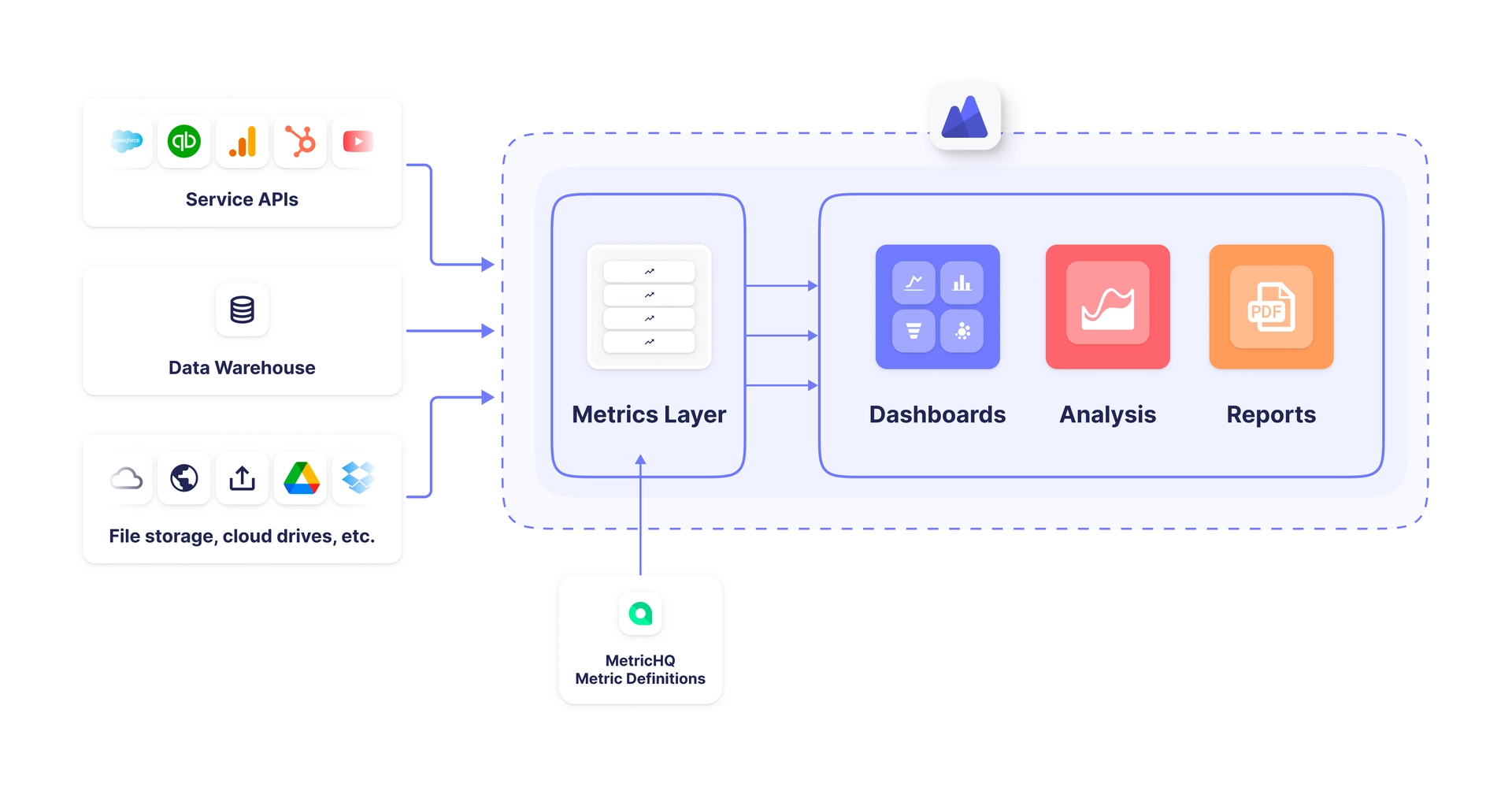
The metric-centric architecture of PowerMetrics:
WYSIWYG (What You See Is What You Get) metrics
Data is abstract. For most people, a metric only makes sense once it is visualized. Metric-centric analytics allows for live previews during the definition process.
- As a data analyst defines a metric, they can see the chart update in real-time.
- They can test different date ranges, segments, and filters immediately to ensure the metric behaves as expected.
- This "no-code" environment allows analysts and business users to fine-tune definitions together, drastically reducing the feedback loops between "the person who needs the data" and "the person who builds the data."
Granular governance
In a metric-centric environment, business and data teams work in the same space. The data team remains the "steward" of the data, controlling access rights and shielding users from the complexity of raw data connections. However, business users are granted the freedom to explore. They can gain a deep understanding of the logic behind the numbers they use daily, fostering a sense of ownership and accountability.
True self-serve BI
True self-service is about more than just "making a chart." It’s about the ability to explore data safely. Because the metrics in PowerMetrics are already governed and "certified," a non-technical user can change a visualization, add a comparison period, or segment by region without any risk of "breaking" the underlying data or writing a single line of SQL.
This leads to significantly higher adoption rates. When people trust the data and find the tools easy to use, they stop asking the data team to build "one-off" reports. In fact, in a mature metric-centric organization, the data team may never have to build a dashboard again. They build the metrics; the business builds the stories.
Building Better Dashboards for the AI Era
Dashboards remain the best way to tell a data story, but in a metric-centric world, they are built differently. Instead of being static collections of charts, they are dynamic windows into your metrics catalog.
By adopting a metric-centric mindset, organizations move beyond the limitations of the old warehouse-centric stack. They create a system where:
- Data Teams manage the integrity and complexity of the query landscape.
- Business Teams get the real-time insights they need for strategy.
- AI Systems have a reliable foundation to provide accurate, natural-language answers.
The future of business intelligence isn't just about having more data—it’s about having one defined and trusted metric used everywhere. Metric-centric analytics is the key to achieving that vision, ensuring that your organization is ready for the challenges of today and the AI-driven opportunities of tomorrow.